What is the Book of Enoch? An accessible guide to 1 Enoch, its sections…
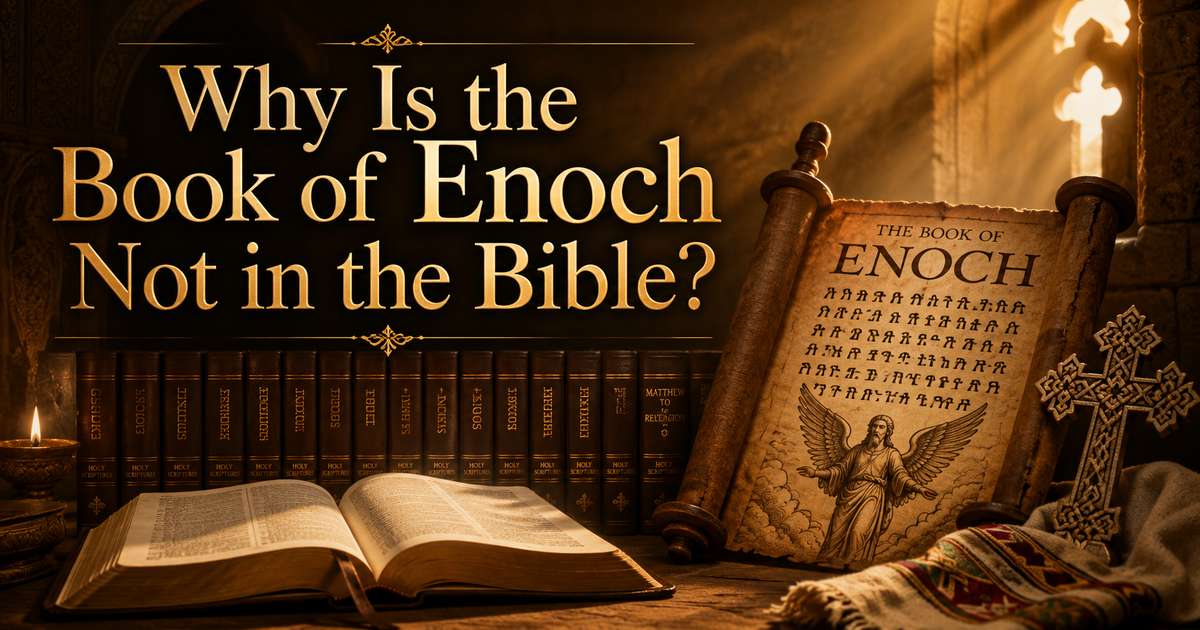
The question "what is the Book of Enoch" points to a surprising and influential work outside most biblical canons. In short: 1 Enoch is an ancient Jewish apocalyptic collection, written under the name of the antediluvian figure Enoch, assembled from several distinct pieces that address angels, cosmic secrets, and final judgment.
Quick answer
1 Enoch is a multi-part Jewish pseudepigraphal work of apocalyptic literature, most fully preserved in Ethiopic manuscripts, with earlier fragments in Aramaic among the Dead Sea Scrolls. It shaped certain Jewish and early Christian ideas—most famously angelology and judgment—but it is distinct from later works called 2 Enoch and 3 Enoch.
What this article reveals
- The five major sections of 1 Enoch and their chief themes.
- How the work fits the Jewish apocalyptic world and why scholars call it pseudepigraphal.
- Why Ethiopic manuscripts and Qumran fragments matter for its history and dating.
- How 1 Enoch influenced early Christian writers and where it stands in different canons.
- How 2 Enoch and 3 Enoch are separate works with later origins and different contexts.
Define the question: what is the Book of Enoch really asking us to read?
People sometimes use "the Book of Enoch" loosely to mean any ancient text about Enoch. That causes confusion. The primary object of interest is 1 Enoch: a composite Jewish work assembled from several independent pieces and attributed to Enoch as a literary device. Calling it "Enoch" does not claim it was literally written by the biblical figure; scholars describe it as pseudepigraphal—meaning written in the name of an esteemed ancestor.
Five major sections: a guided tour of 1 Enoch's structure
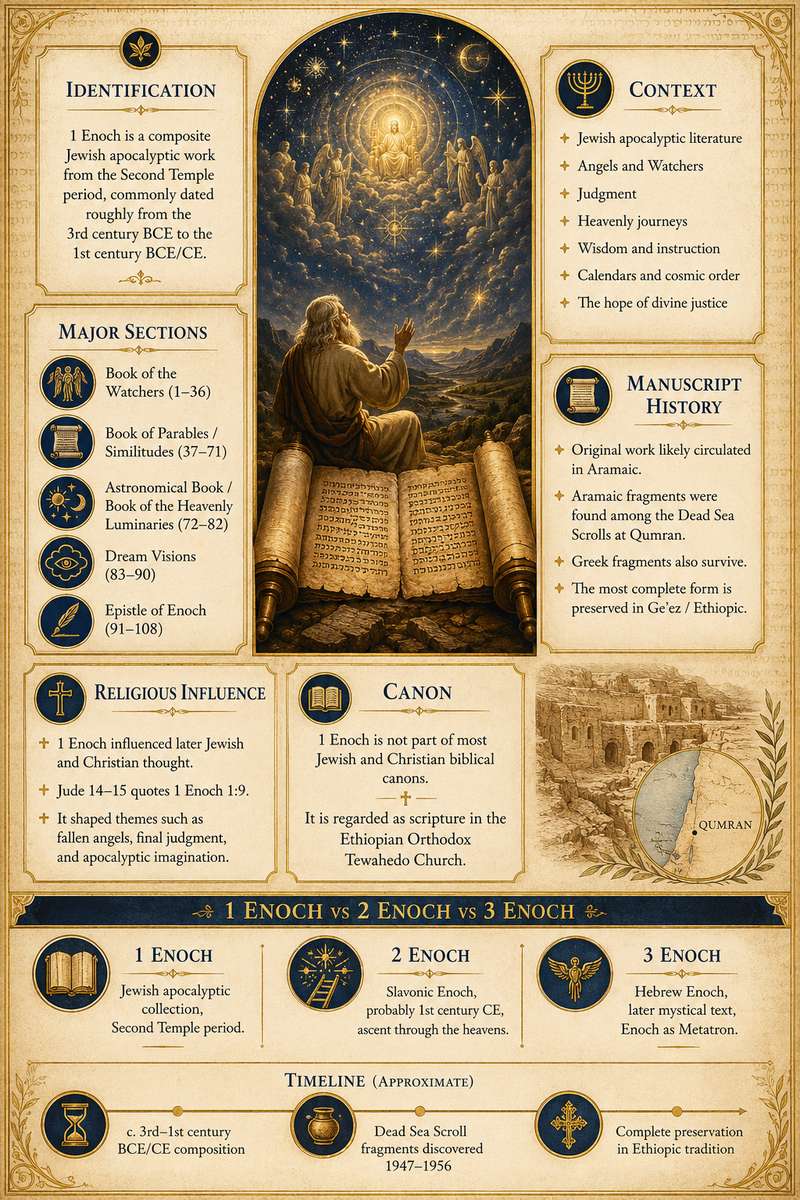
Scholars commonly divide 1 Enoch into five main parts. Each section has its own style and emphasis, which is why the work reads like a collection rather than a single continuous book.
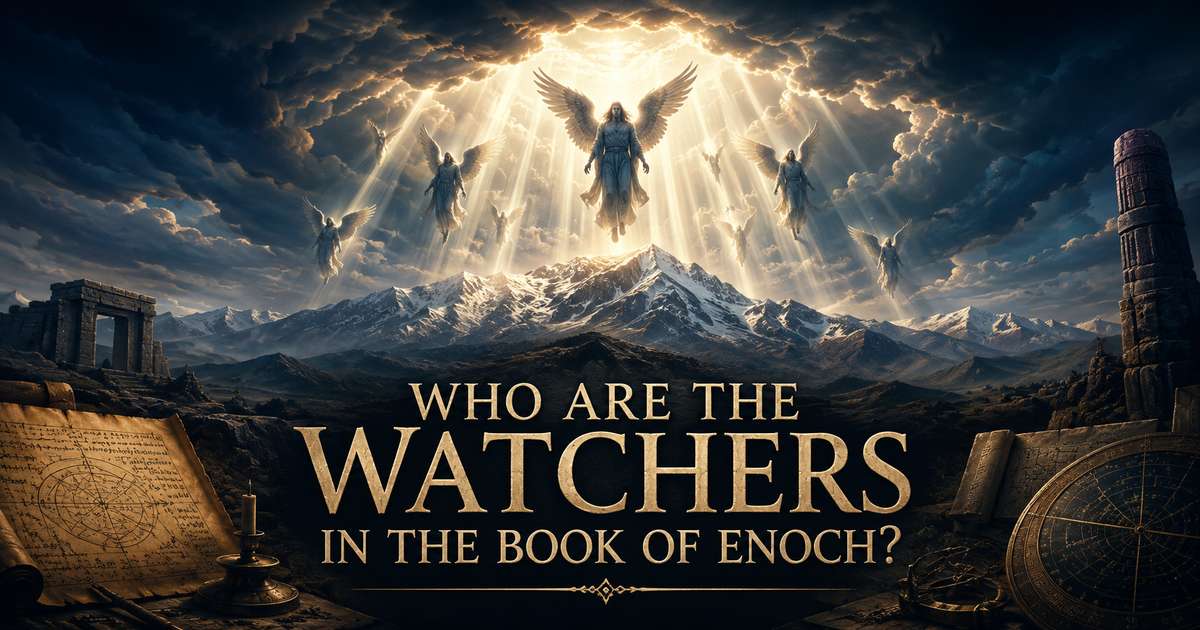
- The Book of the Watchers (chs. 1–36): Presents the story of angelic beings (the Watchers), their illicit union with human women, and the resulting moral disorder—an expansion of themes related to Genesis 6.
- The Book of Parables or Similitudes (chs. 37–71): Contains visionary material, including a striking figure called the "Son of Man" in its imagery; these parables emphasize judgment and vindication.
- The Astronomical Book / Heavenly Luminaries (chs. 72–82): A technical-seeming section concerned with cosmology and celestial cycles—part of the apocalyptic interest in hidden heavenly knowledge.
- The Dream Visions / Book of Dreams (chs. 83–90): Offers symbolic visions presented as dreams, often retelling Israelite history in visionary form.
- The Epistle of Enoch (chs. 91–108): A closing collection of exhortations, apocalypse, and final judgment materials, framed as Enoch’s letters or teachings.
A Jewish apocalyptic work: context and themes
1 Enoch belongs to the corpus of Jewish apocalyptic literature that flourished in the Second Temple period. Typical themes include angelology (notably the Watchers), expansions on Genesis 6 regarding the Nephilim, revelation of heavenly secrets and cosmology, and an emphasis on eschatological judgment. These concerns reflect a world where visionary literature interpreted history and present wrongs in cosmic terms.
Manuscripts and dating: Ethiopic survival and Qumran fragments
The most complete surviving form of 1 Enoch is preserved in Ge'ez (classical Ethiopic). Medieval Ethiopian manuscripts carry the full work, which is why the text is often known as the Ethiopic Book of Enoch. However, much older evidence exists: fragments in Aramaic were discovered among the Dead Sea Scrolls at Qumran (in multiple caves), confirming that substantial portions of 1 Enoch circulated in the late Second Temple period. There are also Greek and Latin fragments and patristic citations, showing a wider ancient transmission even though the Ethiopic tradition preserves the complete text.
Composition dates vary by section: the Book of the Watchers is commonly dated to about the third–second century BCE, other sections fall into the second–first centuries BCE, and parts such as the Parables may be as late as the first century BCE. The composite nature explains the range of dates.
Religious influence: why Christians and Jews read 1 Enoch
1 Enoch left a clear imprint on Jewish and early Christian thought. New Testament evidence shows Enochic influence: the Epistle of Jude directly quotes or alludes to material from 1 Enoch (Jude 1:14–15). Other New Testament and patristic writings reflect motifs found in 1 Enoch—angelic rebellion, expanded Genesis 6 material, eschatological judgment, and even "Son of Man" imagery. That influence does not make 1 Enoch canonical for most churches, but it does explain why early readers found it theologically and imaginatively powerful.
Canonical reception varies: 1 Enoch is outside the Jewish Tanakh and most Christian canons, yet it remained canonical in the Ethiopian Orthodox Tewahedo Church—an important reminder that canons differ between traditions.
Not one series: how 2 Enoch and 3 Enoch differ from 1 Enoch
Other writings bearing the name "Enoch" are separate works, not continuations or late parts of 1 Enoch. 2 Enoch (often called the Slavonic Enoch) survives mainly in Church Slavonic and reflects a Christian-era composition preserved in medieval Slavonic translation; its language and context differ from 1 Enoch. 3 Enoch is a later rabbinic or merkabah mystical text in Hebrew, composed in a much later period and belonging to Jewish mystical tradition. Both 2 and 3 Enoch have distinct provenance, theological emphasis, and manuscript histories, and should not be conflated with the ancient, composite 1 Enoch preserved in Ethiopic and attested at Qumran.
Reading and meaning: what to notice as a Christian reader
When Christians encounter 1 Enoch, useful cautions help: first, identify the text precisely (1 Enoch, not 2 or 3). Second, distinguish between the book’s theological imagination and canonical Scripture. Third, notice how Enochic themes—angels, judgment, cosmic revelation—resonate with, but are not identical to, biblical passages. Appreciating 1 Enoch historically enriches understanding of early Jewish and Christian thought without collapsing it into doctrine for all traditions.
Closing distinction: why the question matters
Asking "what is the Book of Enoch" opens a window onto Second Temple Judaism, the diversity of early religious literature, and the ways certain texts shaped theological imagination. 1 Enoch is neither a single-author Bible book nor a late medieval curiosity; it is a layered Jewish apocalypse with significant manuscript witnesses (Ethiopic and Qumran fragments), clear influence on early Christian writers, and siblings—2 and 3 Enoch—that belong to later, different traditions. Knowing these distinctions keeps historical clarity and theological honesty in balance.
Author: Cynthia D.