
Could You Have Followed Jesus? Life, Loss, and the Cost in First‑Century Judea
Could you have followed Jesus in first‑century Judea? The short answer: yes, people did—but following him often meant immediate and concrete losses. Gospel stories show men leaving nets, families and farms were disrupted, and women provided material support to sustain an itinerant movement. Those facts point to real social and economic strain rather than a harmless spiritual hobby.
Quick answer
Gospel narratives record followers who left livelihoods or family obligations; women financed Jesus' movement; and the wider Roman‑taxed economy and Jewish family structures mean such departures carried clear personal, social, and financial costs.
What this article reveals
- Exactly which Gospel images show people abandoning work and family to follow Jesus.
- How first‑century economic pressures made leaving a trade risky.
- How followers sustained Jesus' itinerant ministry and what that implies about sacrifice.
What the Gospels actually say
The Gospels give the primary textual evidence that people left ordinary life to follow Jesus. Matthew, Mark and Luke describe fishermen—Simon Peter, Andrew, James and John—who "left their nets" or "left their father in the boat with the hired men" and followed him (see Matthew 4:18–22; Mark 1:16–20; Luke 5:2–11). These short narrative notices are concrete: they portray an immediate break with work and household responsibilities.
Jesus' own sayings recorded elsewhere—about "leaving father and mother" and "taking up your cross"—are read by early interpreters and modern scholars as teaching that discipleship could demand renunciation and readiness for suffering (see Luke 14:25–33; Matthew 10:37–39; Mark 8:34–38). Those sayings frame the narrative calls as morally and socially costly, not merely symbolic.
The historical world behind the question
First‑century Galilee and Judea were not a neutral background. Political rule, Temple obligations, and multiple forms of taxation placed economic pressure on peasants, artisans and fishermen. Encyclopedic and historical summaries of Palestine under Roman influence note tribute, local levies and Temple dues as real burdens that shaped daily life. Leaving a trade or household in that context was an economic gamble, not a trivial choice.
Family and household ties were central to identity. Social status, religious participation in the synagogue, and daily support networks depended on remaining within a household economy. Discipleship modeled as leaving household duties therefore disrupted socially expected roles and could mean loss of status and security.
Who paid—and how the movement lived
Luke makes a striking and specific claim about the movement's material underpinnings: several women, named including Mary Magdalene, Joanna and Susanna, "provided for them out of their resources" (Luke 8:1–3). That line is important historically and socially: it shows the itinerant group depended partly on private support, and that women played an active economic role in sustaining Jesus' ministry.
Taken together with the calls of fishermen, the picture is mixed: some followers walked away from livelihoods while others contributed resources to keep the group going. The narrative therefore records both the material strain on individual households and the compensating networks of support within the movement.
What leaving actually cost
From the verified evidence we can identify several concrete costs:
- Loss of regular income and interruption of household labor—fishermen abandoning nets or household heads leaving family economic enterprises (Mark notes James and John left their father Zebedee with hired men in the boat) imply immediate economic disruption.
- Weakened family ties and altered social standing—Jesus' sayings about "leaving father and mother" suggest that disciples risked straining customary filial duties and the social structures that protected them.
- Dependence on benefactors—Luke's list of women supporters shows that followers sometimes became materially dependent on others' resources, which reshaped social roles within the movement.
These costs were practical as well as symbolic: the economy, tax pressures, and household dependency in first‑century Palestine made such personal decisions materially consequential.
How interpretation developed
Early readers and later Christian traditions amplified Jesus' sayings about sacrifice and renunciation. Scholars trace a line from the Gospel texts—brief stories of leaving work and family—into larger theological themes about discipleship's cost. While the Gospels supply the raw material, later Christian reflection turned sayings about "taking up the cross" into enduring moral categories about suffering and commitment.
But historically, those theological developments did not erase the practical facts recorded by the Gospels: people left trades; households faced disruption; supporters provided for itinerant preachers. Both the lived economics and the later spiritual meanings matter when we ask whether a modern reader "could have" followed Jesus then.
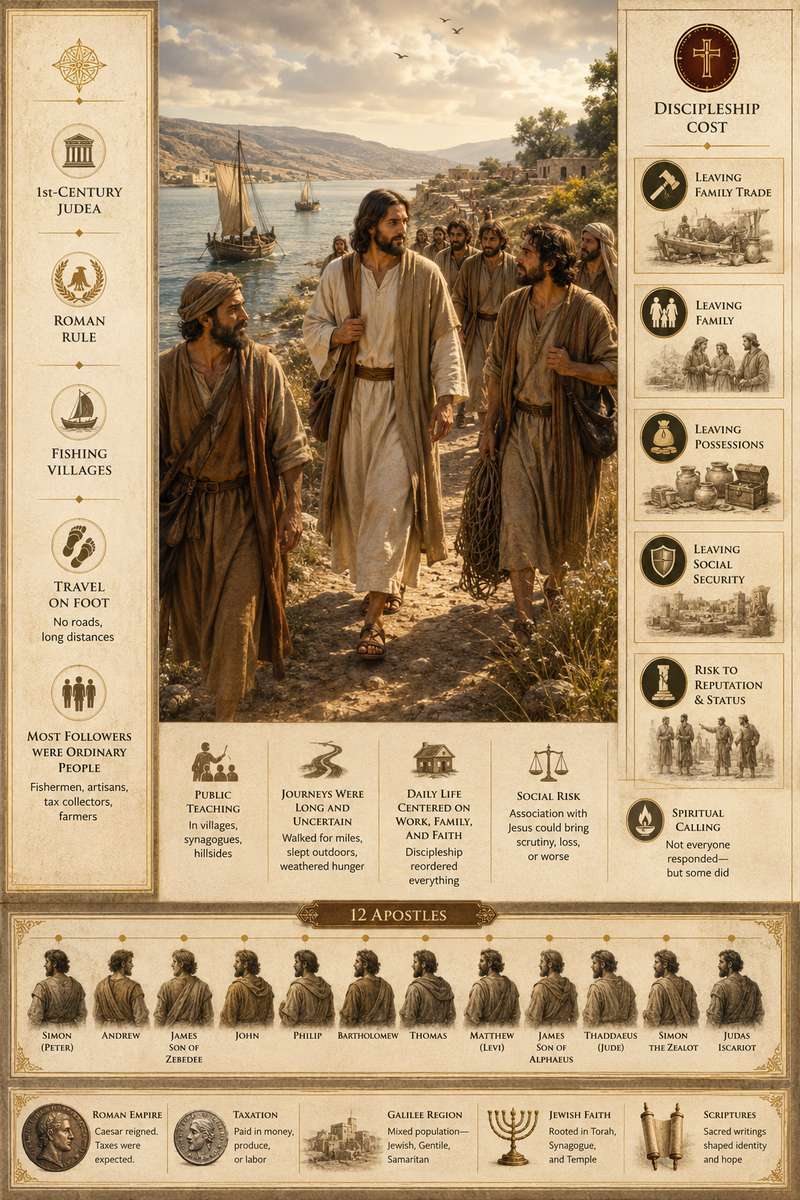
Personal projection: what it meant for ordinary people
If you place yourself in that world—as a fisherman, artisan, or household member—the decision to follow an itinerant rabbi would raise immediate questions: how will my family eat? Who will manage debts or taxes? Will my standing in the local synagogue or village change? The Gospel snapshots imply that some people answered those questions by leaving and trusting networks of support; others may have supported the movement while maintaining household roles.
That ambiguity is part of the historical record: the sources show concrete departures and practical help, but they do not provide inventories or detailed audits of losses. What we can say with confidence is that leaving to follow Jesus was not cost‑free; it intersected with economic vulnerability and social risk.
Limits of the evidence—and what we don't know
The verified sources are clear on the patterns but silent on many specifics. There is no archaeological or extra‑biblical documentation that lists each individual's exact economic loss, nor do we have demographic counts of all who left occupations at particular moments. Gospel narratives provide snapshots rather than full biographies, and modern scholarship cautions against filling gaps with speculation.
So while we can responsibly say followers left livelihoods, households were disrupted, and supporters financed the movement, we must also acknowledge the missing details about long‑term economic outcomes for individual households.
What you can take away
Could you have followed Jesus in first‑century Judea? The sources show that many did—and that doing so meant real personal, social and financial cost. The Gospels record fishermen abandoning nets, Jesus' sayings about renunciation, and women providing material support. Those verified facts map a human picture: discipleship in that setting involved risk, practical dependence, and altered family ties, not merely private conviction.
For modern readers curious about the demands of early discipleship, the lesson is twofold. First, discipleship had material consequences then, shaped by taxation, household economy and social expectation. Second, the early movement's survival depended on mutual support: people left work, others gave resources, and the community together bore the cost.
Author: Cynthia D.