Ichthys Fish Meaning: The Early Christian Fish and Its Visual Legacy
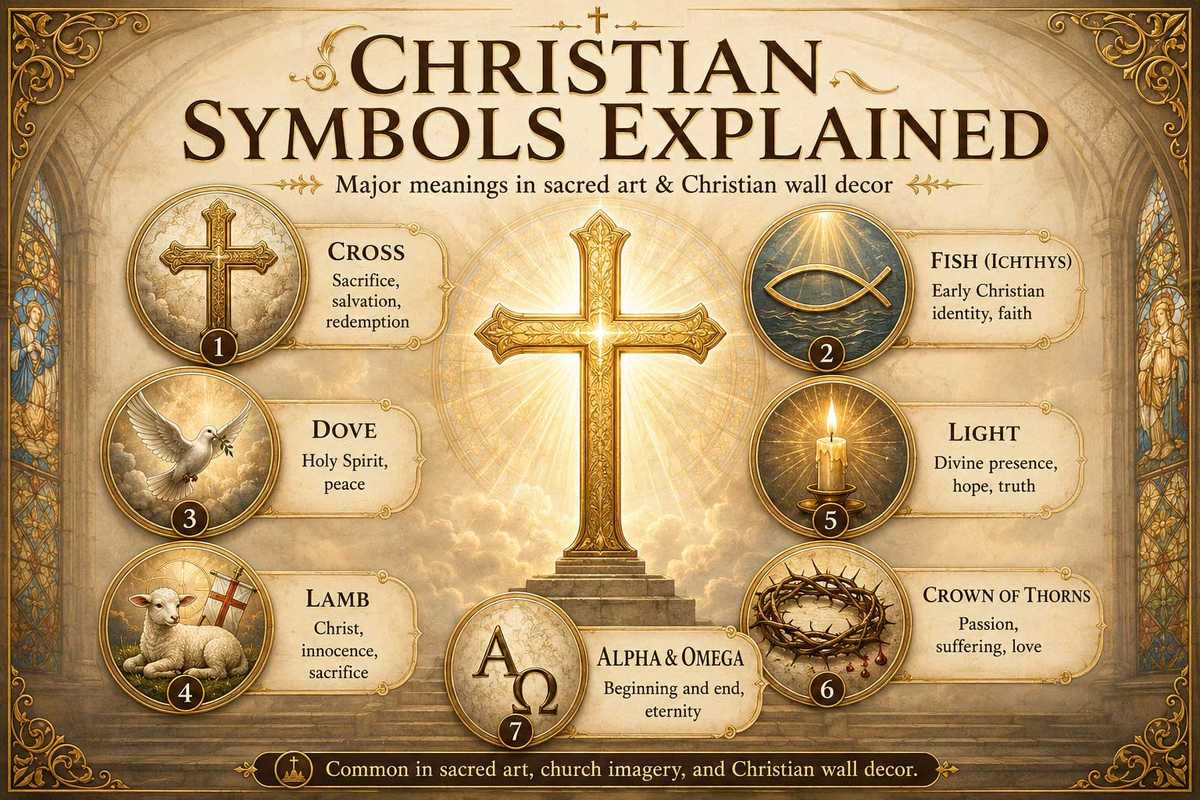
The ichthys (Greek ἰχθύς, "fish") is one of Christianity's oldest symbols. Used by early Christians and resurging in modern visual culture as the familiar "Jesus fish," the ichthys carries short, powerful theological meaning and a long visual life in Christian art and devotion.
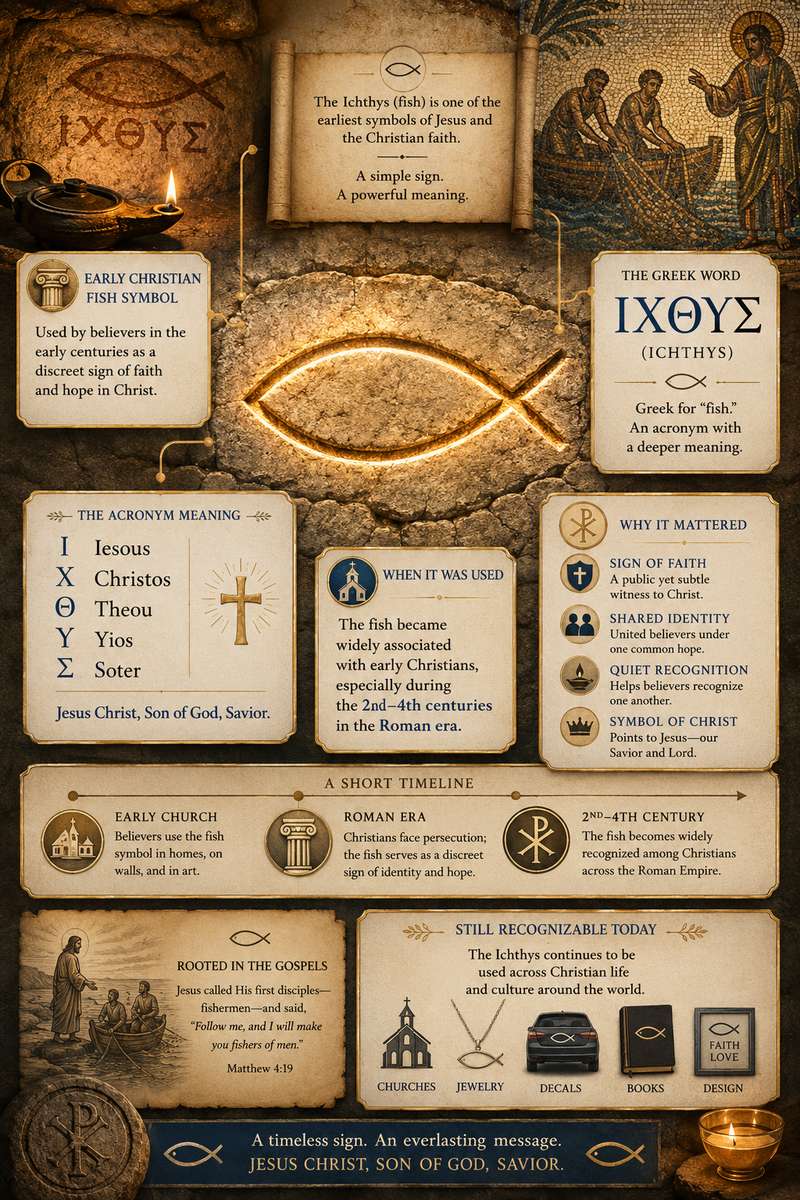
Quick summary: The Greek word ichthys means "fish." Early Christians used the letters ΙΧΘΥΣ as an acrostic for Ἰησοῦς Χριστός, Θεοῦ Υἱός, Σωτήρ ("Jesus Christ, Son of God, Savior"). The symbol appears in early Christian art and inscriptions and later reappeared in modern Christian visual culture.
Use the quick links to jump to sections on symbolism, art, history, and home devotion.
CLEAR DEFINITION
The Greek word ἰχθύς (ichthys or ichthus) literally means "fish." In early Christian use the letters ΙΧΘΥΣ were read as an acrostic standing for Ἰησοῦς Χριστός, Θεοῦ Υἱός, Σωτήρ — "Jesus Christ, Son of God, Savior." That compact theological phrase is the core of what the ichthys fish symbol communicates.
BIBLICAL ROOTS
The validated research block does not provide a single scriptural verse that invents the ichthys acrostic, nor does it claim a precise biblical origin. However, the fish as a motif does resonate with many New Testament scenes—Jesus calls disciples who were fishermen and performs feedings and miraculous catches—which helped make fish an accessible image for early Christian reflection and art. The acrostic interpretation gives the simple word "fish" a direct Christological statement.
HISTORICAL CONTEXT
Archaeological and artistic evidence shows the fish motif in early Christian art and inscriptions, for example in catacomb imagery. Scholars note that the ichthys was among the earliest Christian symbols and was often connected to baptismal and Christological meanings.
Scholars disagree about the precise origins and timing of the ichthys-acrostic and about whether the fish was used widely as a secret recognition sign during periods of persecution. The acrostic explanation is ancient, but the narrative that ichthys served primarily as a covert identification marker is debated and not universally supported by primary evidence.
After the Constantinian era, as the cross and chi-rho gained prominence, the fish remained part of Christian symbolic repertoire but gradually became less central than the cross and other Christological emblems.
CHRISTIAN SYMBOLISM
Visually, the fish is simple and memorable, which helped its effectiveness as a symbol. The acrostic ΙΧΘΥΣ ties the image directly to core Christian confession: Jesus Christ is Son and Savior. Beyond the acrostic, the fish motif carried resonances with baptism and new life in early Christian interpretation, making it suitable for funerary and baptismal contexts in early art.
SACRED ART AND VISUAL LANGUAGE
The ichthys appears in early Christian inscriptions and imagery, including catacomb art. In later centuries the cross and other emblems became dominant, but the fish motif continued to appear in Christian decorative and devotional contexts. In modern times the stylized fish shape reappeared widely as a visual shorthand for Christian identity, used in decals, jewelry, and wall art where its simplicity aids recognition and quiet proclamation of faith.
PRAYER AND HOME DEVOTION
As a devotional image, the ichthys can serve as a compact confession of faith in a home prayer corner or on wall art without elaborate theology. Its associations with baptism and the confession "Jesus Christ, Son of God, Savior" make it appropriate in spaces of remembrance, simple prayer, or family devotion. Using the fish image in a prayer corner can gently remind viewers of baptismal identity and Christ’s saving work.
COMMON MISUNDERSTANDINGS
Two misunderstandings are worth noting. First, while the acrostic explanation is long-attested and widespread, scholars caution that we cannot pinpoint exactly when or by whom the acrostic was first formed; a single, securely dated primary source for that precise origin is not identified in the consulted summaries. Second, the idea that the ichthys functioned mainly as a covert sign of recognition under persecution is debated; this narrative is attractive but not universally supported by primary evidence.
CLOSING INTERPRETATION
The ichthys fish meaning combines a simple Greek word with a concise Christological confession: a humble image that became a theological statement. Its appearance in early Christian art, its debated origins, and its later resurfacing in modern visual culture show how a small emblem can carry enduring spiritual weight. For those arranging a prayer space or choosing wall art, the ichthys offers a brief, recognizable symbol that points to baptismal identity and the central Christian confession of Jesus as Savior.
Author: William L.