
What Would Jesus Ask You to Give Up? Gospel Demands on Wealth, Status, and…
The Gospels ask stark questions: deny yourself, take up your cross, sell what you own, even ‘‘hate’’ your family in order to follow. What would Jesus ask you to give up? The short answer: anything that competes with total loyalty to him—wealth, status, relationships, comfort—and a willingness to suffer rather than abandon discipleship. This article explains what those sayings meant in their first-century setting and how careful readers and pastors have understood them since.
Quick answer
Jesus’ commands to give up possessions, status, or close ties are not merely ascetic suggestions; in the Gospels they function as vocabulary for total allegiance. Practically, Christians are called to surrender whatever "takes Jesus' place," and to accept both daily self-denial and the possibility of suffering for the gospel. Churches differ on whether literal divestment is required for all believers.
What this article reveals
- Which Gospel sayings use harsh language about giving up possessions or relationships and why.
- How first-century context and idiom shape interpretation of sayings such as "hate" family and "take up your cross."
- Why modern Christians agree on the principle but differ about literal divestment and pastoral application.
What is the core demand in the Gospels?
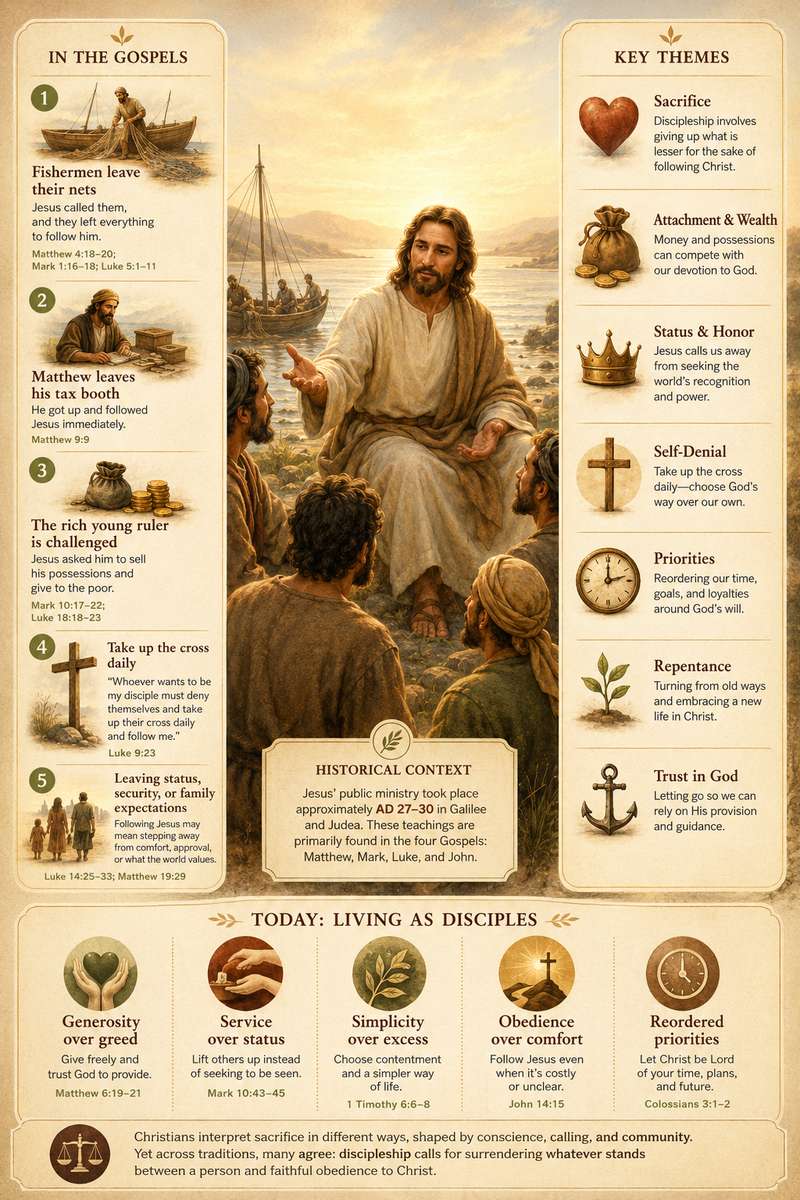
Across the Synoptics a consistent theme appears: discipleship requires renunciation. Key sayings—"deny yourself and take up your cross" (Matthew 16:24; Mark 8:34; Luke 9:23)—use language that conveys both daily self-discipline and openness to persecution or even martyrdom. The immediate thrust is moral and vocational: Jesus calls followers to a loyalty so radical that ordinary attachments must be subordinated or shed.
What the biblical text actually says
The verified Gospel passages include several striking commands. In the episode often called the rich young ruler (Matthew 19:16–22; Mark 10:17–22; Luke 18:18–23), Jesus tells the man to sell his possessions and give to the poor, identifying wealth as a potential competing loyalty. In Luke 14:25–33 Jesus speaks about "hating" family and "giving up all possessions"—phrases many scholars treat as semi-idiomatic, intended to force the listener to weigh loyalties rather than to prescribe literal hatred.
Reading these verses together shows overlapping vocabulary: self-denial, willingness to part with wealth, and the priority of Christ over kin. Each saying contributes to a composite Gospel ethic about what following Jesus can demand.
The historical world behind the sayings
First-century audiences heard renunciation language in a culture where household ties, property, and honour formed personal identity. Commands about leaving family or possessions would therefore signal an extraordinary shift in allegiance. Scholars and pastors point out that idioms—such as the strong word rendered "hate" in Luke—are often rhetorical devices to express preference for Jesus above all rather than an ethic of cruelty toward relatives.
Understanding that background helps explain why Gospel writers use hyperbolic phrasing to stress a real moral choice: follow Jesus even when it costs you the normal securities of life.
How Christian interpretation developed
Across history interpreters have taken both literal and metaphorical routes. Commentaries and pastoral resources represented in the verified material emphasize dual senses: some followers were called to literal divestment and voluntary poverty, while the general teaching aims to loosen possessions and relationships from their hold on the heart. Evangelical and mainline guides commonly translate the demand as readiness to surrender anything that "takes Jesus' place."
That balance — between literal examples (sell and give to the poor) and figurative summons (deny yourself) — explains the variety of Christian responses in preaching and discipleship training.
Why Christians disagree about how much to give up
Contemporary differences come down to how one reads Gospel particularity and pastoral application. Some traditions and teachers stress concrete economic detachment, urging significant giving or communal sharing as normative steps. Others read the core demand as a matter of interior loyalty: you may keep property or status provided they do not displace Christ as your ultimate concern.
Both approaches draw on the same Gospel texts but prioritise different aspects—literal instruction in a narrative example versus broader ethical principle—so disagreement persists without contradiction of the central claim that discipleship costs something real.
Worship, practice, and daily life: what giving up looks like
Pastoral literature presented in the verified sources treats cross-bearing as both a daily discipline and an occasional dramatic choice. Daily self-denial appears in practices like regular generosity, simplicity, or refusing to let reputation and comfort dictate decisions. The more dramatic calls—selling all or accepting persecution—remain rare in most contemporary congregations but are still invoked as vivid tests of where one’s heart lies.
Thus "giving up" functions on a scale: small, habitual sacrifices that re-form character, and larger, episodic acts when the gospel requires public renunciation or costly generosity.
Personal faith and the real-life demand
Practically, the question "what would Jesus ask you to give up?" becomes personal: what do you actually prize above him? The verified reflections encourage a twofold test. First, identify competing loyalties—wealth, status, family comforts, or personal security. Second, ask whether you are willing to surrender those loyalties for obedience, including a readiness to suffer loss.
That test does not produce a single checklist for all believers. Instead it trains a posture: Christians are invited to evaluate their attachments and to practice forms of surrender—generosity, service, willingness to be misunderstood—that concretely reorient life toward Christ.
Closing interpretation: the demand remains radical and pastoral
The Gospel witness is consistent: discipleship costs something—sometimes much. The commands to deny oneself, take up a cross, sell possessions, and prefer Jesus over family are meant to uncover where loyalty truly lies. Historically informed readings temper literalism about "hate" and highlight both metaphorical and literal senses of cross-bearing. Pastors and commentators in the verified material agree that Christians must be prepared to give up whatever competes with Christ, though they differ on whether literal divestment is obligatory for every believer.
So the immediate answer to "what would Jesus ask you to give up?" is not a fixed list but a principle: be ready to surrender anything that replaces Christ as your centre, practiced in daily disciplines of self-denial and, if necessary, in costly public acts of obedience.
Author: Cynthia D.