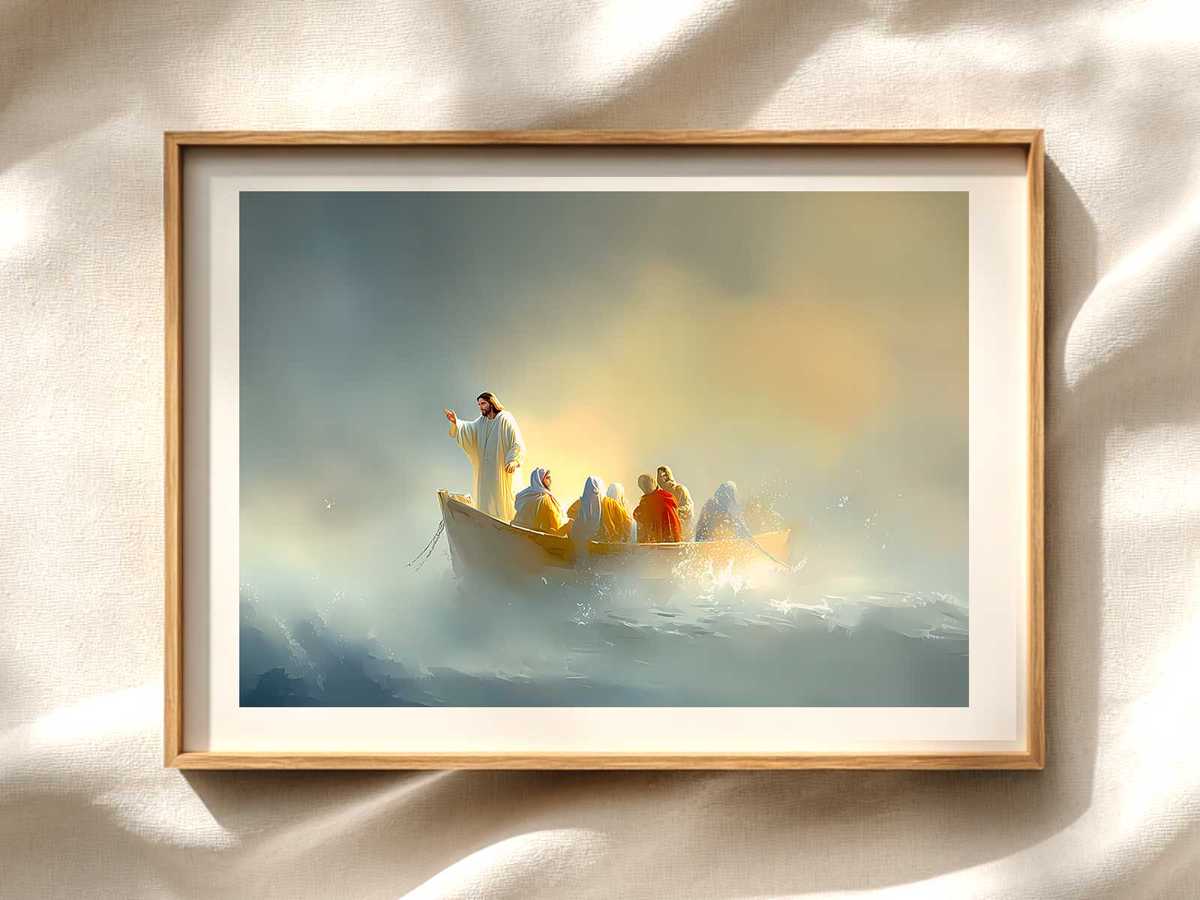
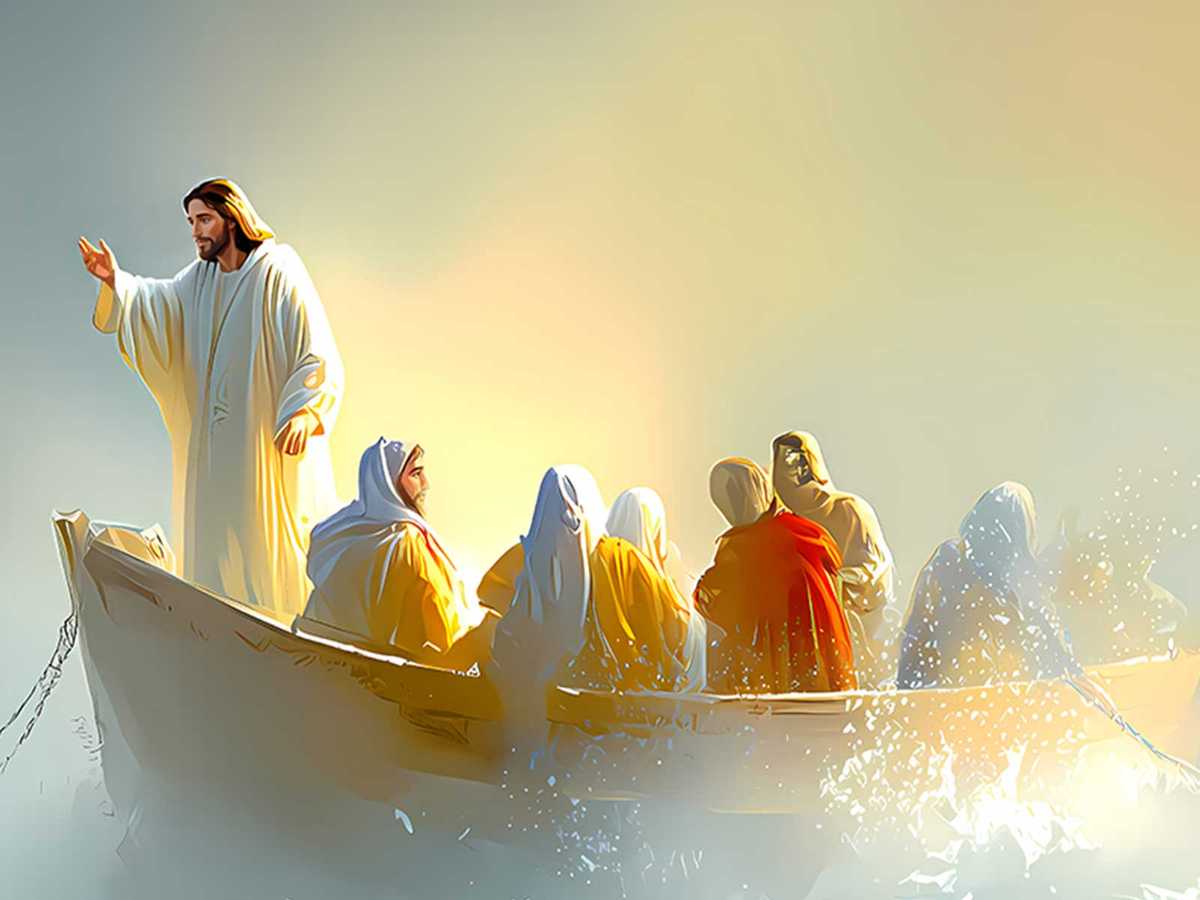
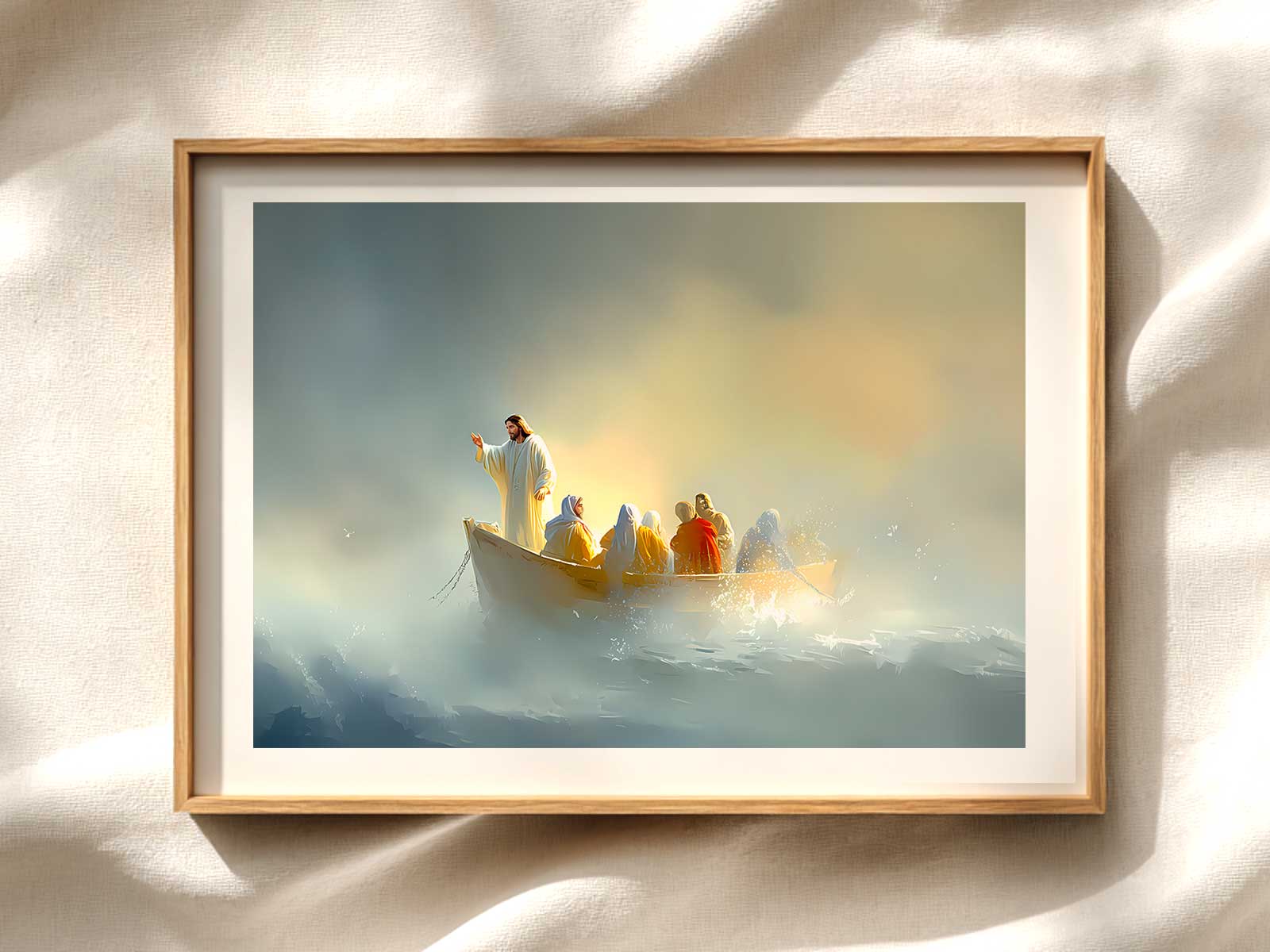
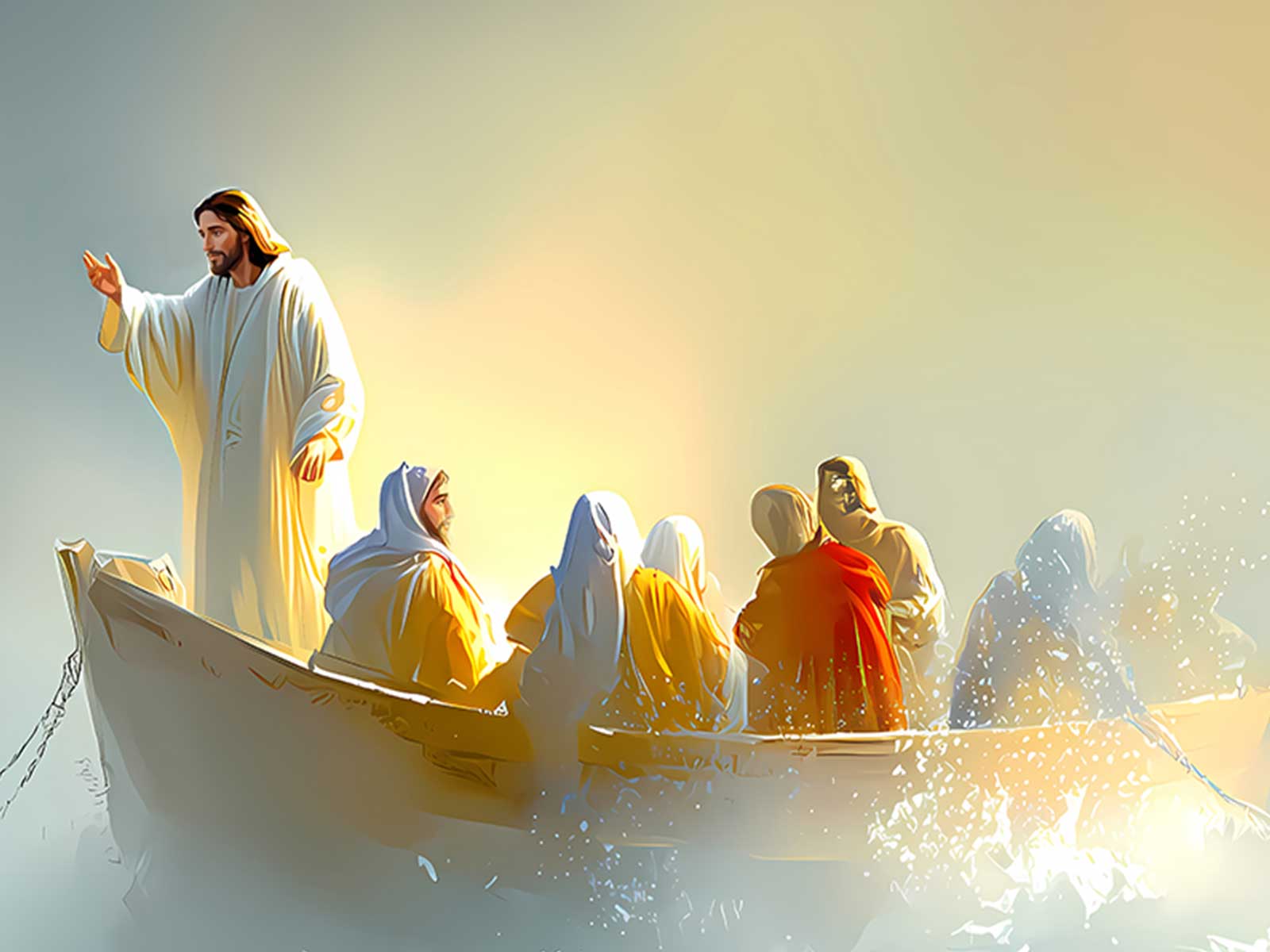
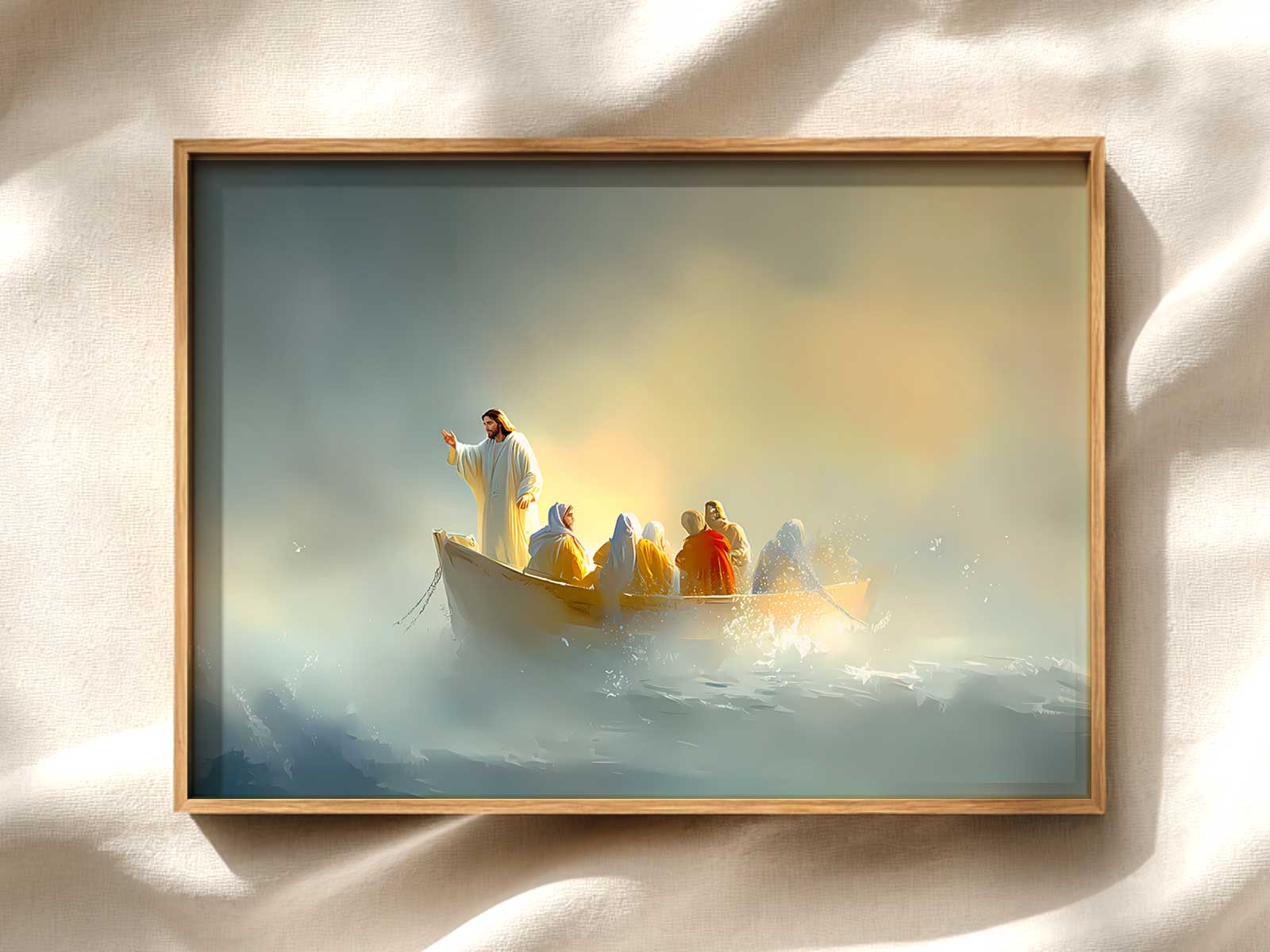
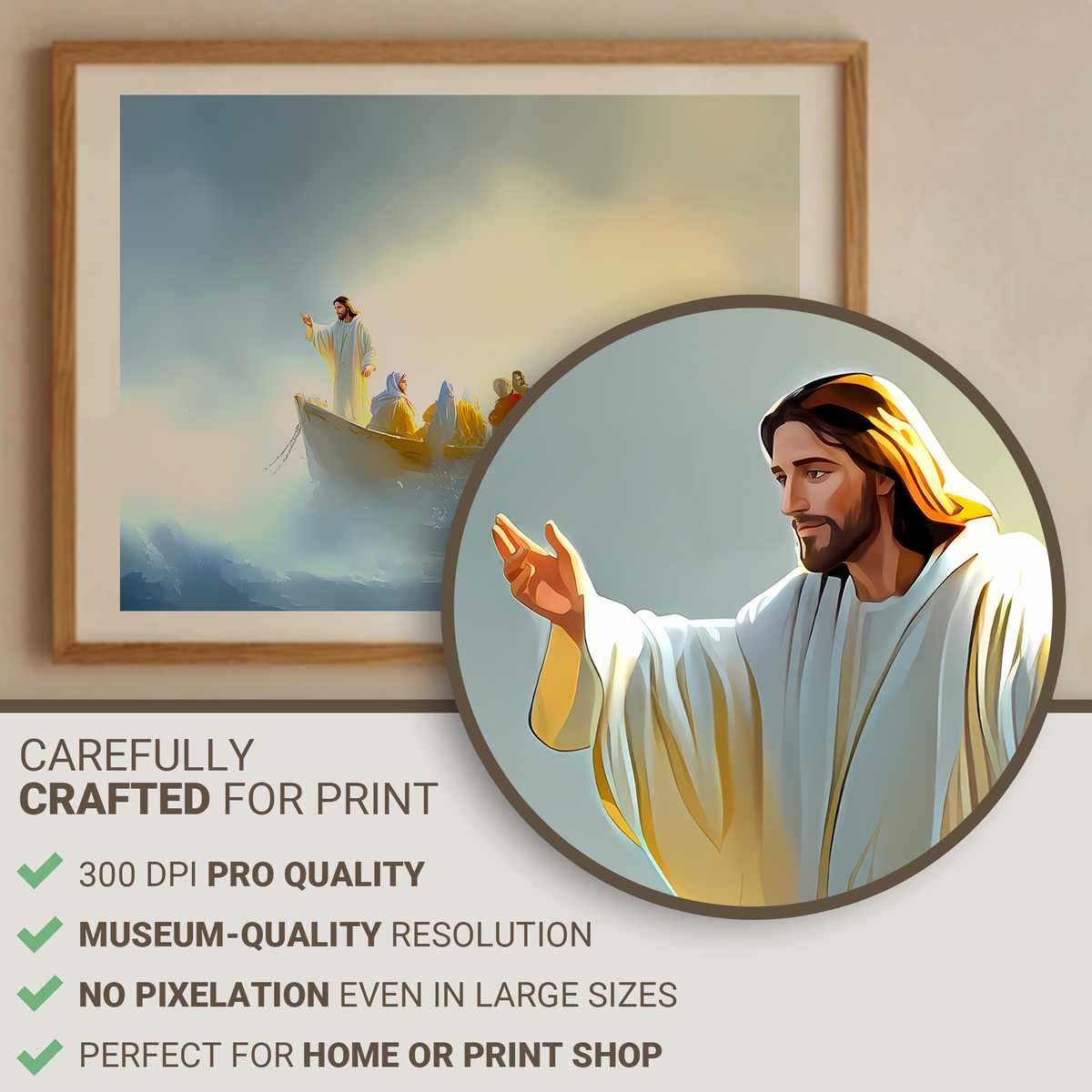
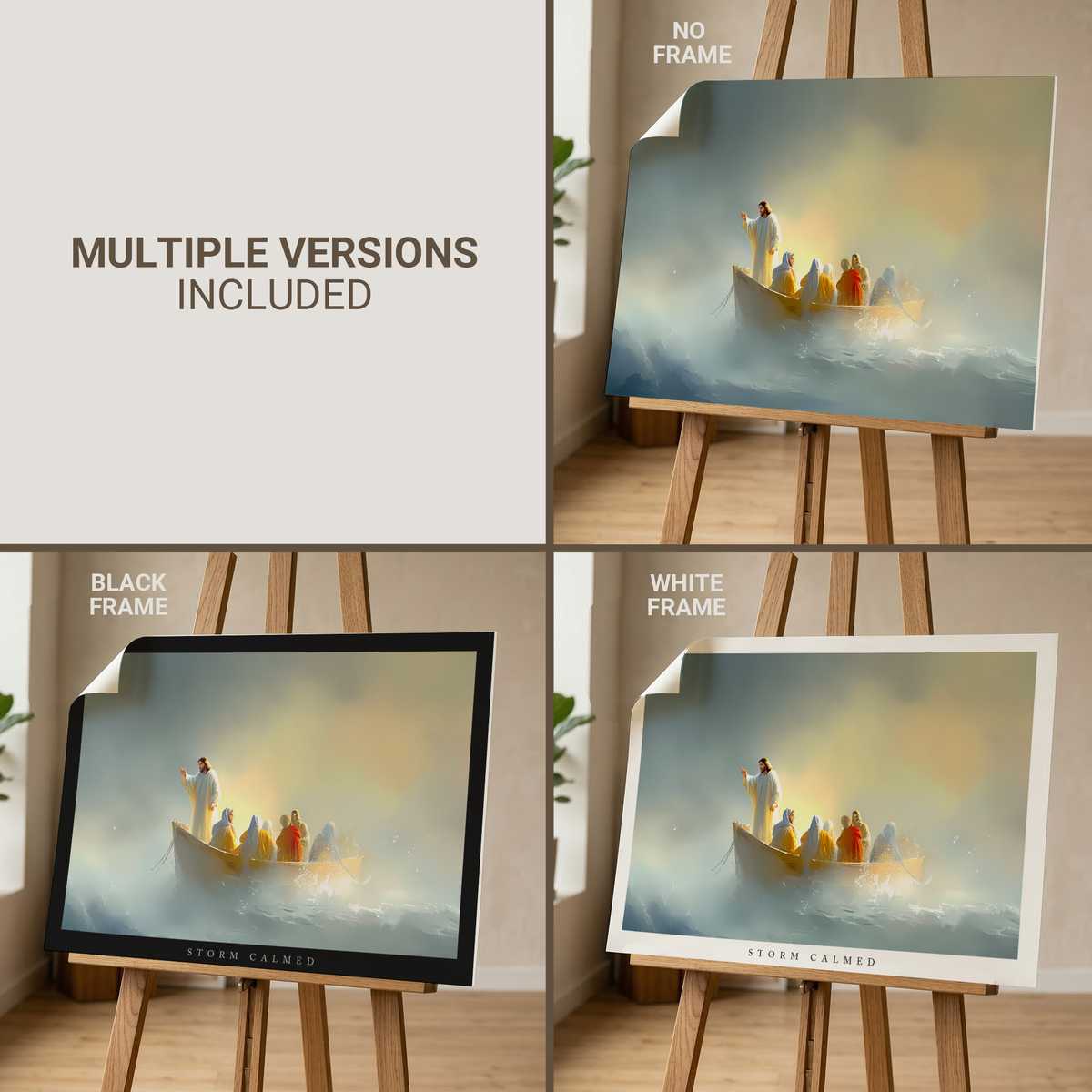
The image centers on a moment when wind and water fall silent beneath the presence of Christ, rendered so that the viewer first feels weather give way to a calm that is not merely absence of noise but a gathered atmosphere of authority and care. This is Jesus art that places the Gospel’s paradox before the household: power that looks like peace. The composition invites the eye to move from restless waves at the lower edge toward the figure whose posture and measured gesture act as the scene’s true horizon.
Visually, the piece reads as a chiaroscuro of motion and repose. A kinetic lower plane of spray and tossed fabric is balanced by stillness around Christ’s face and hands; the paint (or print) treatment makes the water’s turbulence tactile while the light that rests on Christ seems to belong to a different, more contained climate. The viewer understands at once that this is not drama for drama’s sake but a careful study in contrast: chaos framed so that the calm becomes legible and, by that legibility, domesticated for contemplation.
The scene reveals particular things about Christ when contemplated as wall art. His authority appears quiet rather than theatrical: the gesture that hushes the storm is firm but measured, the gaze downward carries concern rather than triumph, and the surrounding light traces a gentle crown of presence without ostentation. These visual choices make the figure less a distant conqueror and more a companion whose power attends the household’s ordinary anxieties—sudden losses, restless nights, the tiny fears of everyday life—and holds them in a steadier hand.
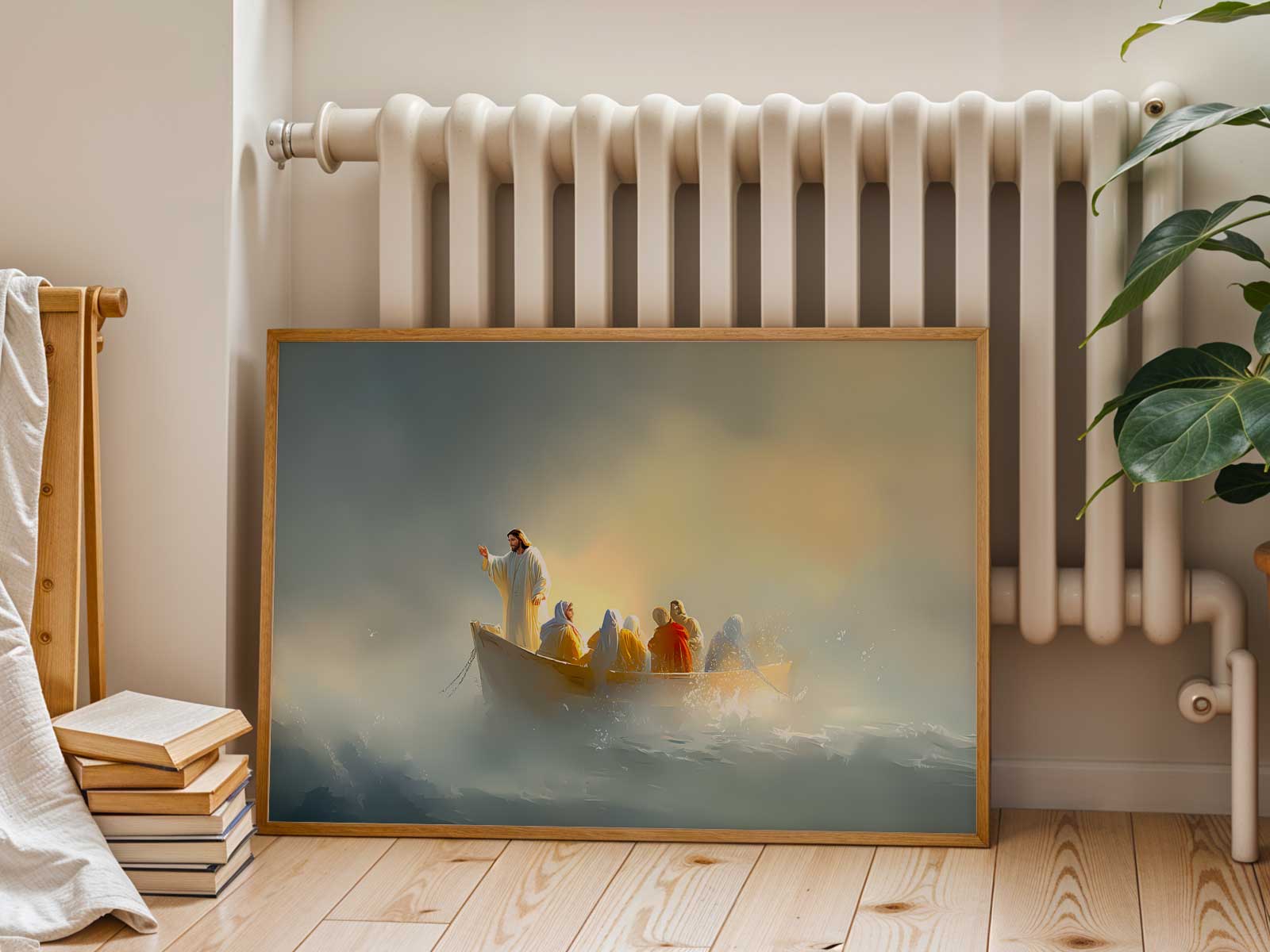
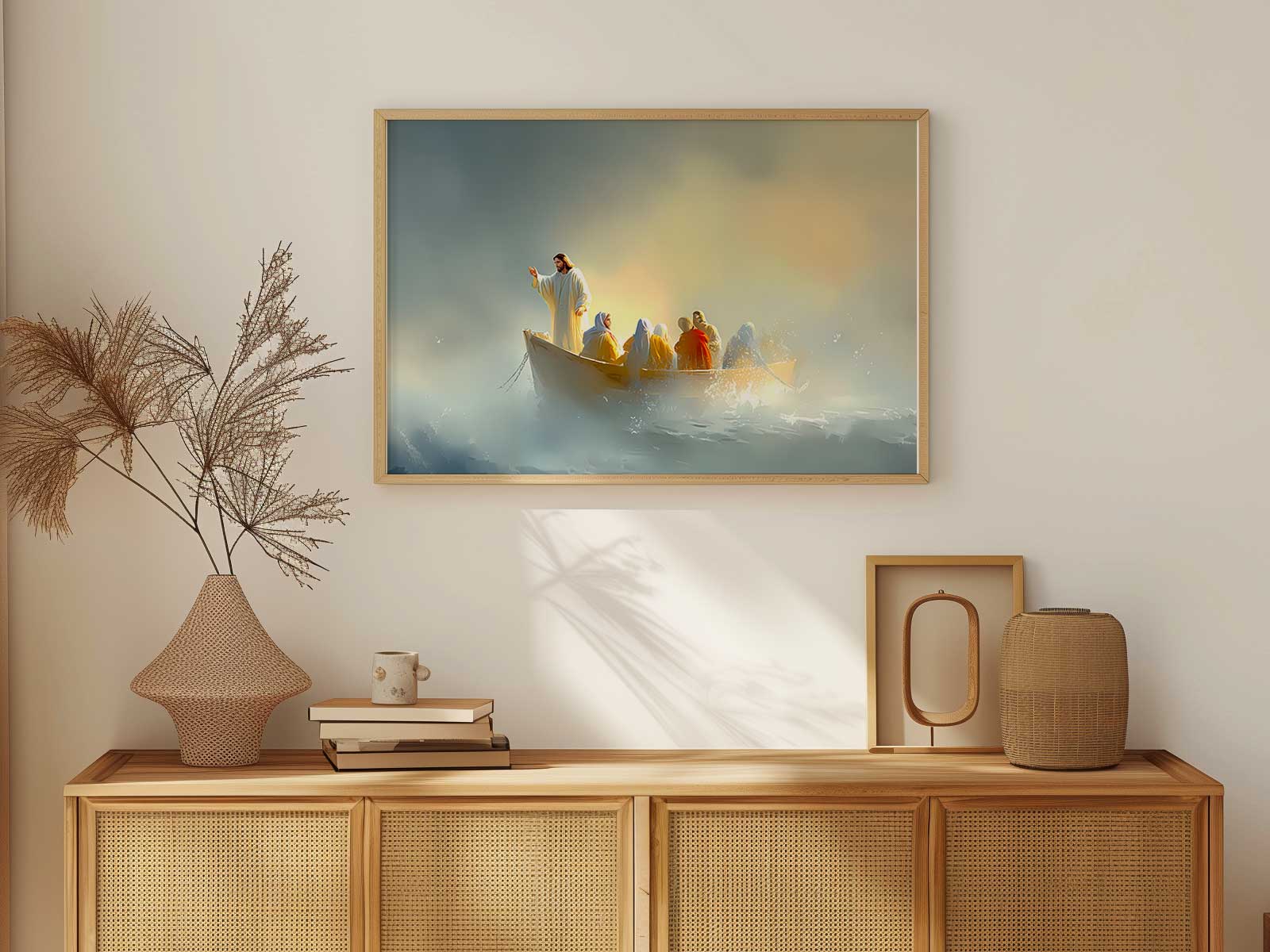
For a prayer corner or bedroom, the composition’s scale and focal clarity support a simple liturgical rhythm: a moment to pause, breathe, and let the eye find the calm center. The artwork does not demand explanation; it offers a posture. Placed above a bedside table, near a reading chair, or by a small home altar, it encourages a twofold practice of looking and listening—looking at the calm within the painting and listening inwardly for a corresponding quiet in one’s own spirit.
Decoratively, the piece provides a bridge between sacred symbolism and domestic warmth. Earthy tones in the lower registers harmonize with wood furniture, while the soft, contained light around Christ complements neutral walls and creates a focal point that reads as both devotional and design-conscious. The work’s emotional steadying comes from trained contrasts: movement that makes the stillness feel earned, and intimacy that makes authority feel like protection.
As a gift for a friend entering a season of change or for families wanting a reminder of gentle guardianship in their home, the image carries a meaning that is specific and personal rather than generic. It does not preach; it holds. Its strength as wall art lies in its capacity to be seen repeatedly without growing familiar in a way that quiets reflection. Each glance becomes a small sacrament of reorientation—a daily invitation to remember that the power that calms storms also tends the small interior weather of a human life.



 ↧ Digital download
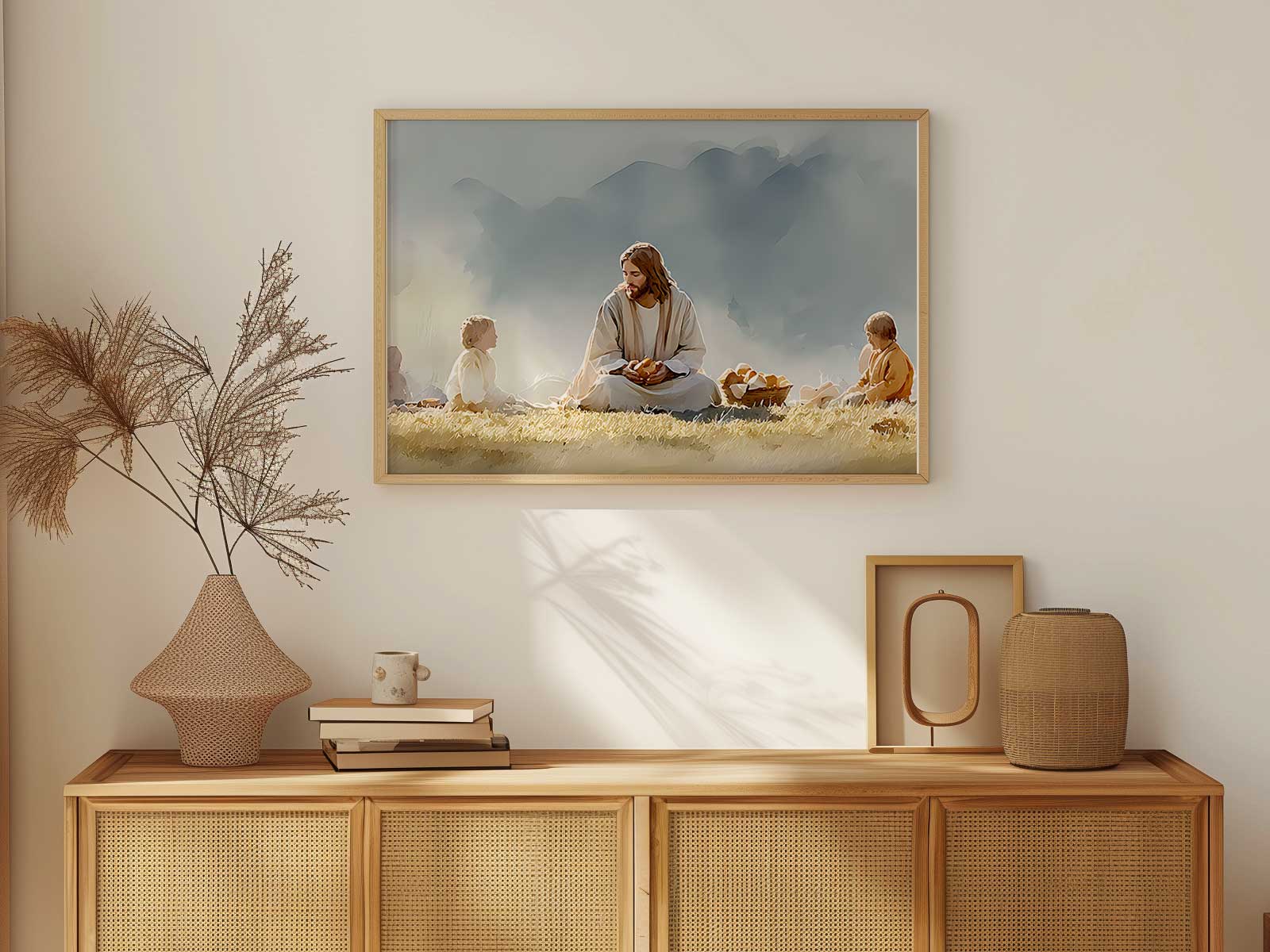
Christian Wall Art: Feeding the Five Thousand and Trust in Providence
Digital download
↧ Digital download
Christian Wall Art: Feeding the Five Thousand and Trust in Providence
Digital download
 ↧ Digital download
Jesus Walking on Water: A Sacred Image of Trust Amid Fear — Jesus...
Digital download
↧ Digital download
Jesus Walking on Water: A Sacred Image of Trust Amid Fear — Jesus...
Digital download
 ↧ Digital download
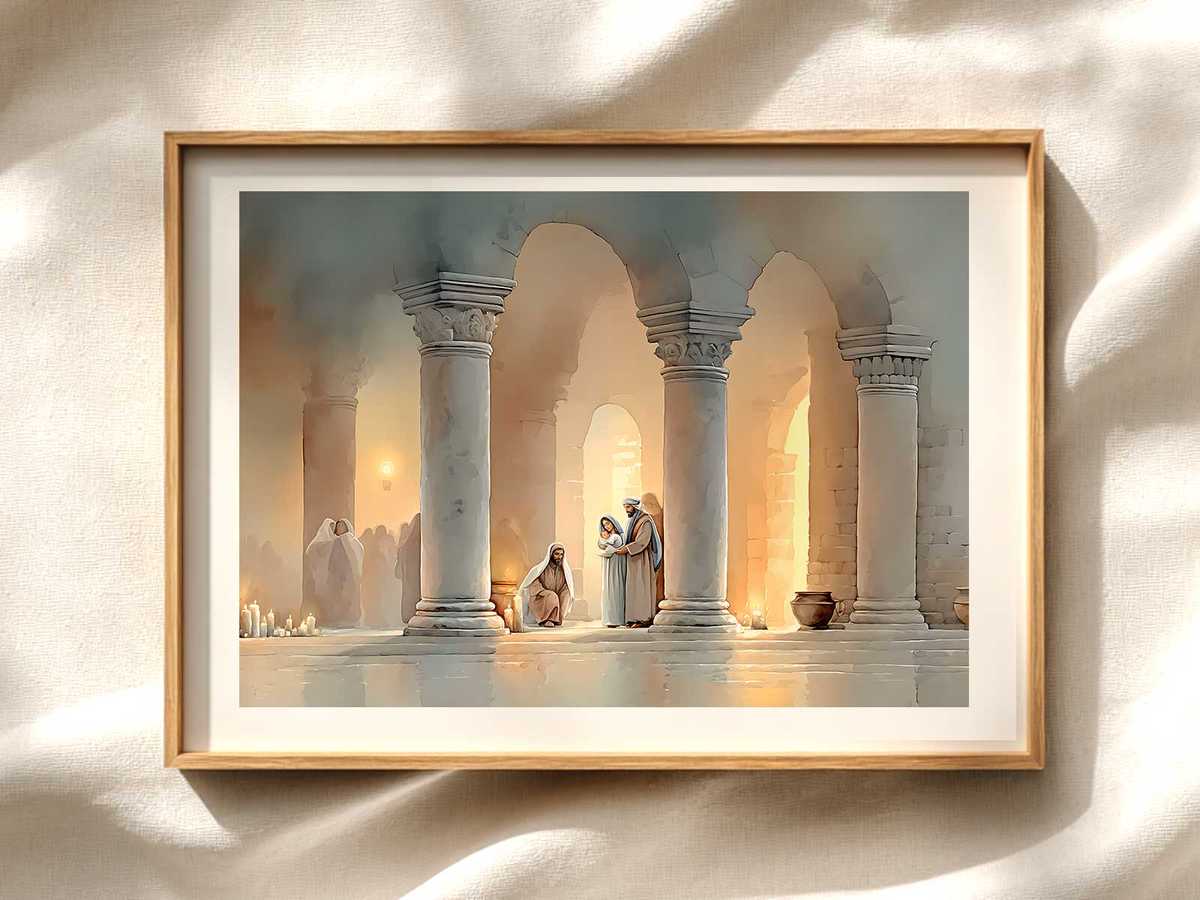
The Christ Child in the Temple: A Sacred wall art for Quiet Home...
Digital download
↧ Digital download
The Christ Child in the Temple: A Sacred wall art for Quiet Home...
Digital download
 ↧ Digital download
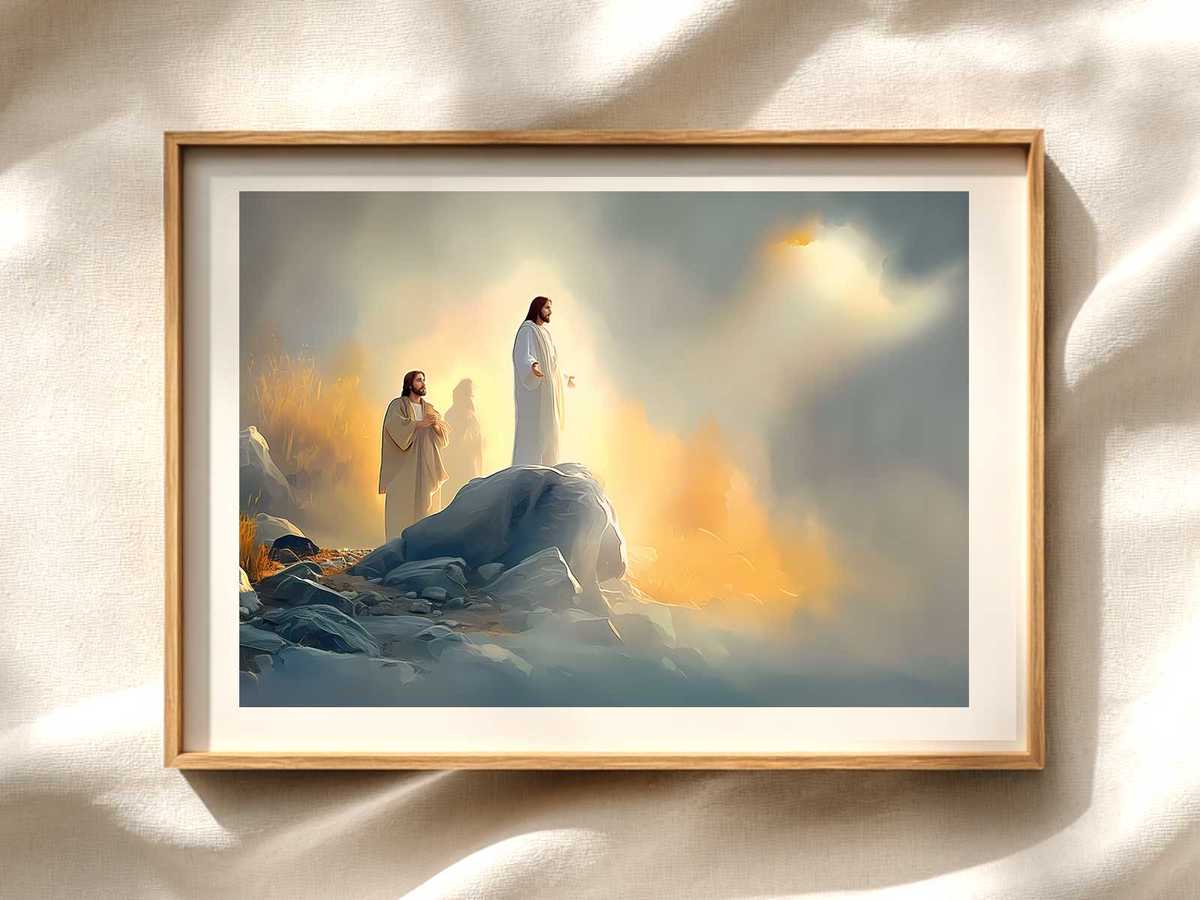
Famous Christ Painting Wall Art: The Transfiguration as Sign of...
Digital download
↧ Digital download
Famous Christ Painting Wall Art: The Transfiguration as Sign of...
Digital download