Who are the Watchers in the Book of Enoch? A clear guide to their descent…
The Book of the Watchers (1 Enoch 1–36) tells a striking ancient Jewish story that expands Genesis 6:1–4. In brief: the Watchers are angels sent to watch over humanity who rebel, descend to earth, teach forbidden arts, take human wives, sire the Nephilim, and are ultimately judged—events the text links to the corruption that brings the Flood.
Quick answer
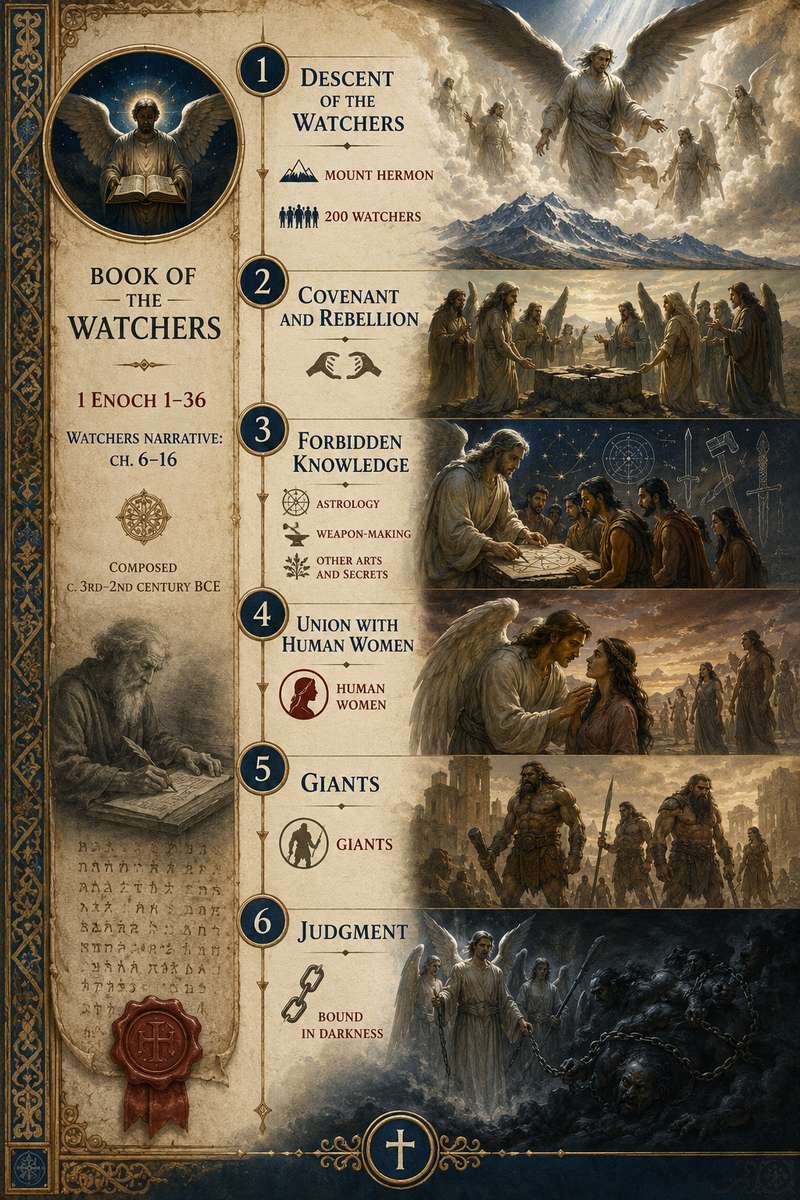
The Watchers in the Book of the Watchers are angels appointed to guard humanity who break their role: about 200 descend, swear an oath on Mount Hermon under a leader named Semyaza, take human wives, father the Nephilim, teach forbidden knowledge (notably through a figure called Azazel), and receive divine punishment that helps bring about the Flood.
What this guide examines
- How 1 Enoch expands Genesis and identifies the Watchers as fallen angels.
- Which teachings the text calls forbidden and who is named as teacher.
- How the Watchers’ unions with human women and the Nephilim figure into Enoch’s narrative of corruption and judgment.
What is the Book of the Watchers and why it matters
The Book of the Watchers is the opening section of 1 Enoch (chapters 1–36). It is an ancient Jewish apocalyptic work from the Second Temple period that retells and expands the brief Genesis notice about the “sons of God” marrying human women. Because it develops that motif into a full narrative, the Watchers section became influential in later Jewish and some Christian writings.
Although the complete text survives in Ge'ez (Ethiopic), fragments of the Watchers material were also found in Aramaic among the Dead Sea Scrolls, and the tradition shows up in early Christian literature—Jude, for example, echoes Enochic themes. Scholars date the layer broadly to between the 3rd and 1st centuries BCE.
Who exactly are the Watchers in the story?
In 1 Enoch the Watchers are angels—sometimes called “sons of God” or by the Greek-influenced term egrḗgoroi (“Watchers”)—entrusted to watch over humanity. Instead of keeping their assigned role, a group of these angels rebel. The narrative names a leader, Semyaza (also spelled Semihazah or Samyaza in the textual tradition), who, with about 200 others, descends to earth and binds the others by oath on Mount Hermon.
Descent, oath, and the decision on Mount Hermon
The text emphasizes a dramatic moment of descent: the angels come from heaven and make a collective pact—an oath that binds them to remain with their chosen action. This group action under a leader frames the rebellion not as isolated disobedience but as an organized transgression that alters the boundary between the heavenly and human realms.
Forbidden teaching: what the Watchers gave humanity
One of the key accusations in the Book of the Watchers is that the fallen angels taught humanity dangerous or forbidden knowledge. The text singles out specific arts and secrets—metalworking and weapon-crafting, cosmetics or beautification, astrology or the signs of the heavens, sorcery, and other hidden things—as taught by these angels. A prominent figure in these accusations is Azazel (sometimes Asael), who is associated with instructing humanity in these practices.
The narrative treats such instruction as morally and socially corrupting. Rather than being neutral advancement, the knowledge contributes to violence, vanity, and occult practices that destabilize human communities and offend the divine order in the Enochic imagination.
Unions with human women and the Nephilim
The Watchers take human wives, and from these unions come offspring called the Nephilim—often described as giants. The appearance of the Nephilim is central to the Book of the Watchers’ account of increasing evil on earth: the monstrous offspring and their deeds intensify human wickedness, providing one of the explicit reasons the text links these events to the impending Flood.
Divine response: Enoch, angelic envoys, and punishment
The Book of the Watchers stages a narrative of divine reaction. Angelic agents such as Uriel are sent to report the corruption; the patriarch Enoch receives revelations and intercedes. Nonetheless, the story records the binding and imprisonment of the ringleaders—Azazel is explicitly named among those bound—and a broader sentencing of the Watchers. The text presents this judgment as causally connected to the decision to bring the Flood against a world corrupted by the Watchers’ deeds.
Literary shape and historical dating
Scholars place the Book of the Watchers in the Second Temple period (roughly 3rd–1st centuries BCE), marking it as one of the oldest layers of Enochic literature. Its treatment of Genesis material, the names it supplies (Semyaza, Azazel), and its apocalyptic framing helped the work travel through Jewish and early Christian circles. The survival pattern—complete in Ge'ez with Aramaic fragments at Qumran—explains why the book is canonical in the Ethiopian Orthodox Tewahedo tradition but non-canonical elsewhere.
Why Christians and Jews have different responses
Interpretation and reception of the Watchers vary because the Book of the Watchers is not part of every community’s canon and because the text itself mixes genres—history, revelation, and apocalyptic symbolism. Some readers treat it as plausible expansion of Genesis tradition; others regard it as an imaginative theological explanation for evil and the Flood. The presence of Enochic themes in Jude shows the text’s early influence, but reception history makes it clear that canonical status differs by tradition.
What the story asks of readers and faith communities
As an editorial observation: the Book of the Watchers asks readers to notice the moral frame behind certain ancient anxieties—knowledge that corrupts, breaches between heavenly and human realms, and social breakdown resulting from pride and violence. For Christians and Jews interested in how ancient texts explain evil, the Watchers narrative offers a richly symbolic account rather than a straightforward historical report.
Closing interpretation: separating text, tradition, and imagination
The Watchers in the Book of the Watchers are best understood on three levels that the text itself uses: (1) as angels who abandoned their charge, (2) as narrative agents who transmit forbidden knowledge and father corrupt offspring, and (3) as the mythic cause in an apocalyptic explanation for divine judgment culminating in the Flood. The work is a powerful Second Temple window into how ancient readers expanded a brief Genesis motif into a full story about boundary-crossing, sin, and punishment.
Author: Alex R.