Why is the Book of Enoch not in the Bible? A short history of canons and…
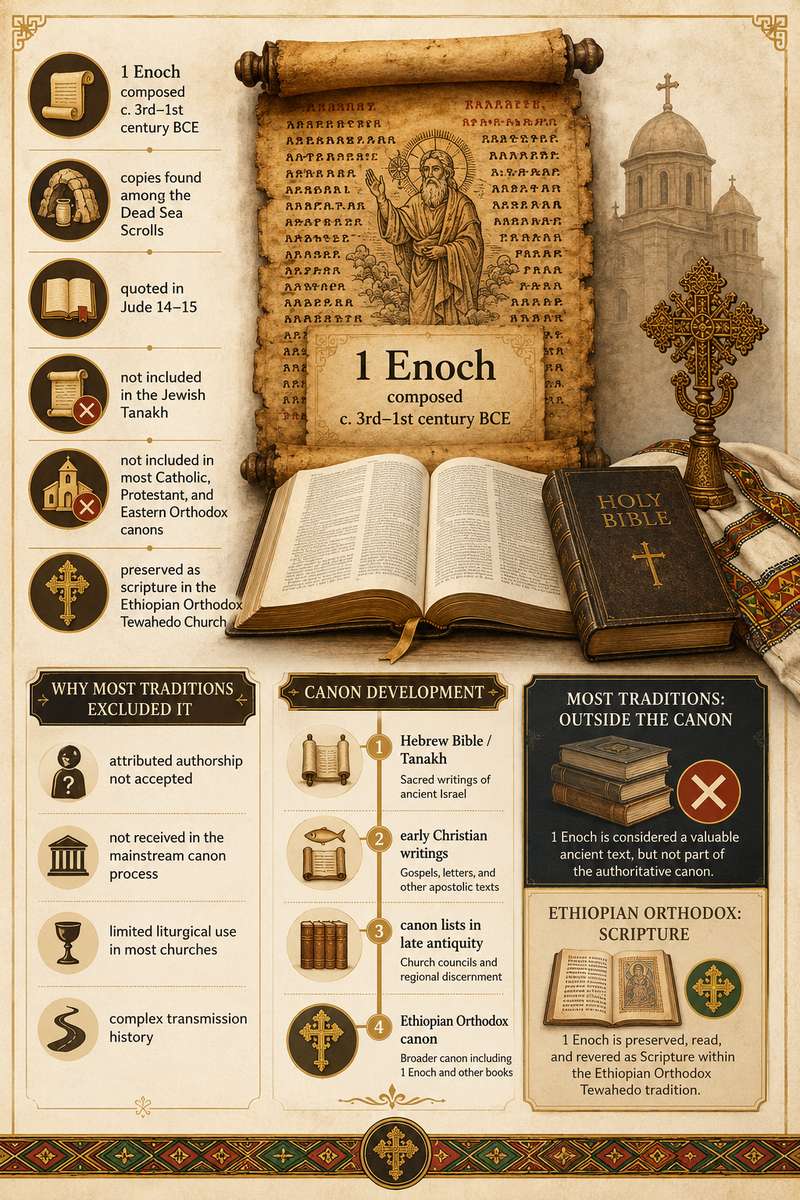
The quick answer: 1 Enoch circulated in the centuries before and around Jesus, influenced some Jewish and Christian readers, but was not accepted into the mainstream Jewish or most Christian canons because of questions about authorship, textual transmission, and uneven early acceptance. The Ethiopian Orthodox Tewahedo Church preserved a complete Ge'ez text and continued to treat 1 Enoch as scripture, a result of its distinctive textual history and relative isolation.
Quick answer
1 Enoch is an ancient Jewish apocalyptic collection (multiple layers, c. 3rd century BCE–1st century CE). Fragments at Qumran and an echo in Jude show its influence, yet its pseudepigraphal character, uneven acceptance, and lack of a continuous Hebrew tradition kept it out of the Jewish Tanakh and the canons later adopted by most churches. A full Ge'ez text survived in Ethiopia, where the Ethiopian Orthodox tradition includes it in a broader canon.
What this article reveals
- How ancient circulation and later canon-formation followed different criteria than mere popularity.
- Which concrete reasons scholars give for 1 Enoch's exclusion from most canons.
- Why Ethiopia uniquely preserved and canonised the book in Ge'ez.
Defining the question: what exactly is 1 Enoch?
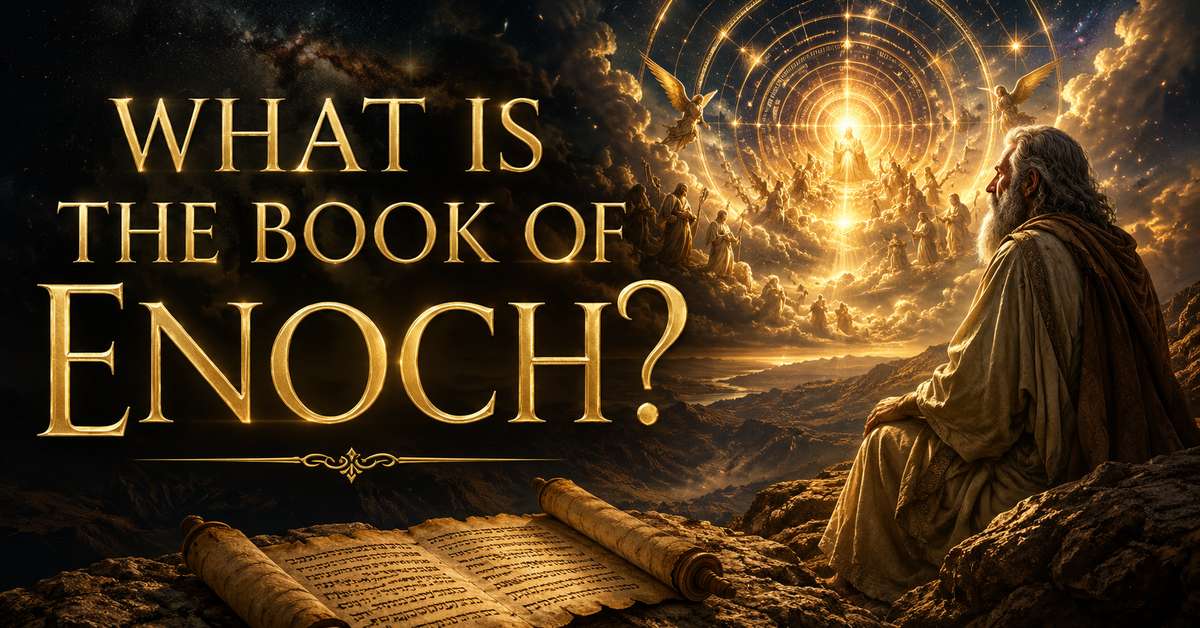
When people say the "Book of Enoch" they most often mean 1 Enoch (the Ethiopic Book of Enoch), a composite Jewish apocalyptic work made up of several sections written in different periods. Scholars commonly date its composition between the third century BCE and the first century CE. It is not a single-author, single-date text but a layered collection of visions, cosmological material, and moral judgment framed as words of the antediluvian figure Enoch.
What the text says and where it shows up in early literature
1 Enoch contains vivid apocalyptic imagery—heavenly journeys, angelic beings, and judgments—that resonated with certain Jewish and Christian readers. Importantly, fragments of 1 Enoch in Aramaic were discovered among the Dead Sea Scrolls at Qumran, demonstrating that some Jewish sectarian circles knew and used it before and around the time of Jesus. In the New Testament, the Epistle of Jude appears to quote or allude to material found in 1 Enoch (Jude 1:14–15), indicating early Christian familiarity with the book.
How biblical canons developed: criteria and contingency
Canon formation was neither instantaneous nor uniform. Jewish and Christian communities relied on various, sometimes competing, criteria: apostolic origin or prophetic authority, consistent use in worship and teaching, theological agreement with received doctrine, and the availability of a stable textual tradition in languages those communities used.
For the Jewish Tanakh and for the major Christian canons that later prevailed in Roman Catholic, Protestant, and most Eastern Orthodox contexts, these criteria produced a narrower collection of books. Texts that were widely circulated might still be excluded if questions remained about origin, doctrinal compatibility, or textual transmission.
Why most Jewish and Christian traditions did not include 1 Enoch
Several concrete reasons explain why 1 Enoch was not accepted into the Jewish Tanakh or most Christian canons:
- Pseudepigraphal character: 1 Enoch is attributed to the ancient figure Enoch rather than to a provable prophet or apostle. Communities forming canons were often cautious about works whose asserted authorship was not authenticated.
- Theological and doctrinal differences: as rabbinic norms developed and Christian doctrine crystallised, some content in 1 Enoch clashed with emerging theological frameworks or was judged extra-biblical in character.
- Lack of a continuous Hebrew textual tradition: the canonical Jewish books were tied to texts preserved and used in Hebrew (or authoritative translations). 1 Enoch did not maintain a continuous Hebrew textual stream used by rabbinic authorities.
- Uneven early acceptance: although influential in some circles (Qumran, certain Christian readers), 1 Enoch’s acceptance was not consistent across the major early Christian centres whose judgments shaped later universal canons.
Why the Ethiopian Orthodox tradition preserves 1 Enoch
The Ethiopian Orthodox Tewahedo Church (and the related Eritrean Orthodox tradition) includes 1 Enoch in a broader biblical canon. Two historical facts help explain this distinctive reception.
First, the complete surviving text of 1 Enoch is preserved in Ge'ez, the classical liturgical language of Ethiopia. That full Ethiopic text was available within Ethiopian Christianity when many other traditions only knew fragments or had lost reliable copies.
Second, Ethiopia's historical isolation and its unique process of receiving and integrating scriptures meant that certain books accepted there did not enter the Western or Byzantine canonical mainstream. The survival of a full Ge'ez manuscript tradition allowed 1 Enoch to remain part of the Ethiopian broader canon when it was marginalised elsewhere.
What this means for readers and faith communities
The case of 1 Enoch illustrates a broader point about sacred books: authority depends on historical reception, textual transmission, and theological fit as much as on age or influence. A text can shape belief in some communities (as 1 Enoch did in parts of early Judaism and in some Christian circles) without becoming universally canonical.
For Christians today, knowing that Jude echoes 1 Enoch helps explain shared apocalyptic language and themes, but it does not mean every tradition must treat 1 Enoch as scripture. Different communions apply different standards, and the Ethiopian example shows that a living canon may reflect local history and preservation as much as ancient authorship.
Hidden tensions and respectful curiosity
Two tensions are important to recognise. First, historical influence is not the same as canonical status. 1 Enoch influenced religious imagination without gaining universal acceptance. Second, canonical boundaries are historically contingent; what one tradition preserves may be absent in another without implying suppression or conspiracy—often the reasons are pragmatic: which manuscripts survive and which communities adopted them.
Closing interpretation: a balanced takeaway
Why is the Book of Enoch not in the Bible? Because canon-formation weighed authorship, doctrinal fit, textual continuity, and broad acceptance—standards that 1 Enoch failed to meet across most Jewish and Christian networks, despite its antiquity and influence. The Ethiopian Orthodox Tewahedo Church preserved a complete Ge'ez text and received it into a broader canon, a historically rooted exception rather than evidence of deliberate suppression.
Author: Cynthia D.