Could You Survive in the Time of Jesus? A Clear Look at Daily Life in…
Could you survive in the time of Jesus? Short answer: materially, many people lived harsh, precarious lives—small farms, shared households, limited diet, constant travel risks, and real disease—but survival was ordinary rather than heroic. Understanding what that ordinary life looked like helps us read the Gospels and imagine discipleship without romanticising the past.
Quick answer
If you were an ordinary resident of first‑century Judea you would probably survive day to day by farming, craft or seasonal labour, eating a mostly plant-based diet, using local networks for travel and pilgrimage, and relying on communal religious practice — but you would also face frequent sanitary and health hazards plus political and travel insecurity.
What this guide examines
- Staple foods and how diet shaped health and work capacity.
- How people moved, worked, and made a living in villages and towns.
- Evidence for disease, sanitation, and everyday dangers from archaeology and texts.
The historical world behind the question
Archaeological syntheses and textual studies reconstruct a landscape of villages, market towns, and the pilgrim city of Jerusalem in Roman Palestine. Most people combined small‑scale agriculture with craftwork or seasonal labour. Material remains—houses, tools, and installations found in museum displays and reconstructed sites—show daily activities like food processing, weaving, pottery, and ritual immersion.
What people ate: staples, scarcity, and celebration
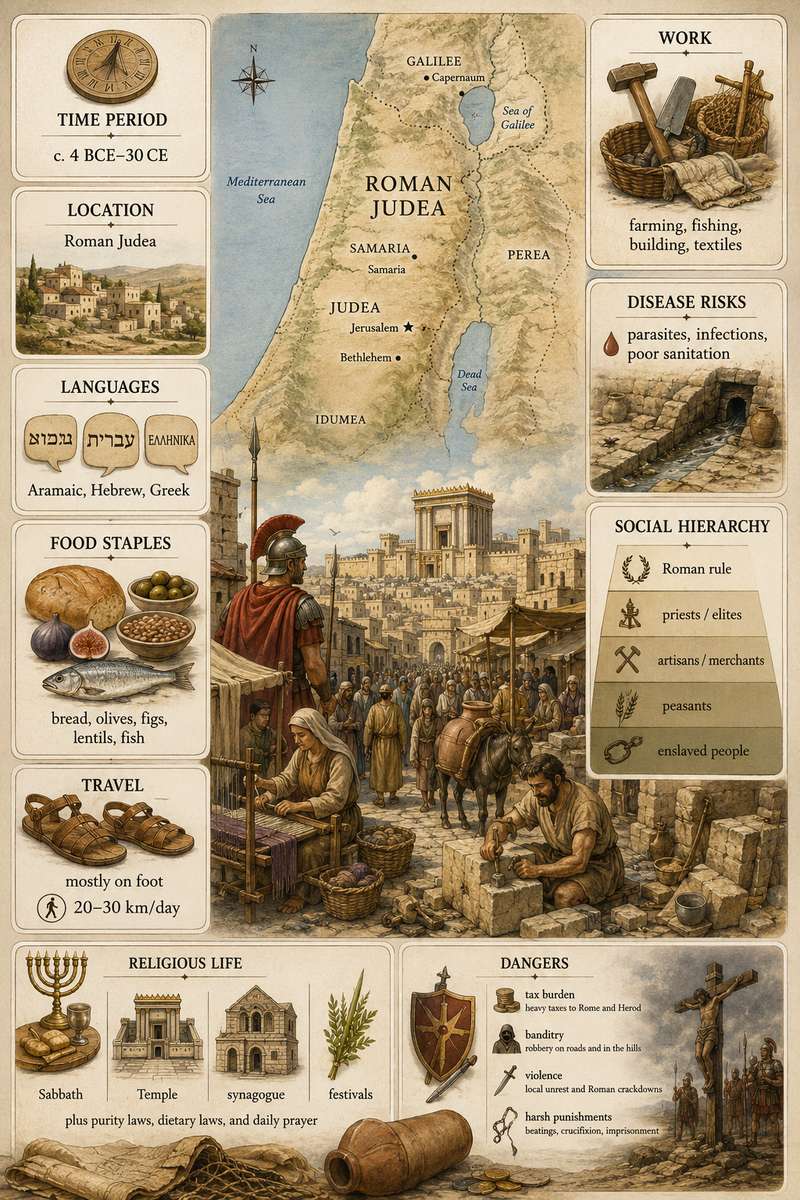
The basic diet for the majority was simple and largely plant-based. Bread made from barley and wheat, olive oil, wine, and pulses such as lentils and beans formed the staple. That diet could sustain hard physical labour but left little room for variety. Meat was available but uncommon in ordinary households and more often reserved for wealthier families or festival occasions. Archaeology and focused studies emphasise how everyday food preparation and storage shaped family life and work rhythms.
Work, crafts, and how households survived
Economy and work revolved around agriculture—grain, olives, grapes—alongside animal husbandry and regionally specific trades such as fishing in Galilee and carpentry in towns. Many households mixed subsistence farming with craft production and occasional wage labour to make ends meet. Evidence from archaeological hand‑tools and domestic installations shows that craftwork was often integrated into family life rather than confined to workshops detached from the household.
Travel and the realities of movement
Travel was usually on foot or by pack-animal like donkeys and mules. Roads and seasonal routes linked villages, market towns, and pilgrimage destinations such as Jerusalem, but long-distance movement could be slow, costly, and risky. Pilgrimage to the Temple or journeys to markets required planning and local support networks; travel hazards and the expense of transport were real constraints on mobility.
Disease, sanitation, and health risks
Archaeological and bioarchaeological studies show that infectious disease and parasitic infections were present in first‑century contexts. Research including molecular studies from burial sites confirms pathogen DNA in the environment. Contemporary medical knowledge in the Greco‑Roman world offered limited remedies, and poor sanitation made populations vulnerable. These conditions made surviving childhood and old age more precarious than modern readers might assume.
Social layers: riches, middling households, and the poor
Material culture reveals a layered society. Elites—large landowners, Temple priesthood, and those connected to administration—left traces of larger houses and imported goods. Most people fell into a range of free peasants, artisans, and smallholders whose houses and tools show modest means. Poorer rural and urban households are visible in smaller dwellings and simpler burial practices. These differences affected diet, mobility, legal standing, and access to religious centres.
Religious practice and daily life
Jewish religious life combined Temple-centred sacrificial cult in Jerusalem with local synagogue life, ritual purity rules, and Sabbath observance. Archaeological evidence—such as miqva'ot or ritual baths—and textual study show how ritual immersion and purity practices intersected with ordinary tasks like food preparation. Diverse sectarian expressions existed in this period, reflected in differing emphases in texts and material remains.
Everyday dangers beyond disease
Aside from health risks, people faced theft, travel hazards, and periodic political or military violence. Textual sources and archaeology attest to episodes of unrest and traces of conflict that made certain periods and places more dangerous. Safety often depended on local networks, kinship ties, and the occasional patronage of wealthier neighbours.
What this would demand from a modern reader imagining survival
To picture surviving in that era honestly: expect a life embedded in family and local economy, with steady physical labour, a limited but nutritionally adequate diet for most adults, and significant risks from disease and instability. Communal and religious structures offered social support but did not eliminate material precarity. Survival was typically incremental and communal rather than a solitary test of endurance.
Why these facts matter for reading the Gospels
Understanding staple food, travel constraints, and social hierarchy helps interpret many Gospel scenes more realistically. Garden labour, village hospitality, pilgrimage imagery, and the occasional miracle account sit inside a world where resources were limited, travel was arduous, and ritual obligations shaped public life. Knowing this context sharpens both historical reading and spiritual imagination without turning texts into mere historical footnotes.
Final reflection: survival without romanticising
Could you survive in the time of Jesus? Most people did survive—but within a world of narrow margins. Archaeology and textual evidence invite us to respect the daily resourcefulness, community bonds, and religious practices that made ordinary life possible, while refusing to gloss over disease, poverty, and danger. That balance both deepens historical empathy and preserves the ethical and spiritual seriousness of walking with those first‑century communities in imagination and study.
Author: Alex R.