Halo Meaning in Christian Art: Light, Glory, and the Signs of Holiness
The halo meaning in Christian art points to holiness, divine light, and heavenly glory. Known also as the nimbus, aureole, or gloriole, this circular or radiating disk of light is a visual shorthand that identifies figures set apart by sanctity or divine presence.
Quick summary: The halo is an ancient visual device adapted into Christian art by late antiquity to depict heavenly radiance. Variations—simple circular halos, cruciform halos, full-body aureoles and mandorlas—communicate different levels or kinds of sanctity.
Reader preview: Learn the basic definition, the halo’s pre-Christian roots, distinctions among nimbus, aureole and mandorla, conventions for Christ and saints, and how the symbol functions in sacred images and home devotion.
CLEAR DEFINITION
In Christian iconography a halo (also called nimbus, aureole or gloriole) is a circular or radiating disk of light placed around the head or body of a figure to indicate holiness, divinity, or sanctity. As a visual device it signals that the person depicted participates in heavenly radiance rather than ordinary human light.
BIBLICAL ROOTS
While the verified sources describe the halo as a long-standing artistic convention rather than a directly quoted biblical term, its theological meaning—divine light or glory—resonates with scriptural language about God’s radiance and the transfiguring presence of God. Christian artists adopted the device to make visible the spiritual truth often expressed in Scripture as light and glory.
HISTORICAL ORIGINS
The halo has pre-Christian origins in Hellenistic, Roman, and other ancient cultures and was adapted into Christian art in late antiquity. Christian use is attested by the 4th–5th centuries and is firmly established by the 6th century. Over time the device became a regular part of Christian visual language.
CHRISTIAN SYMBOLISM: FORMS AND TERMS
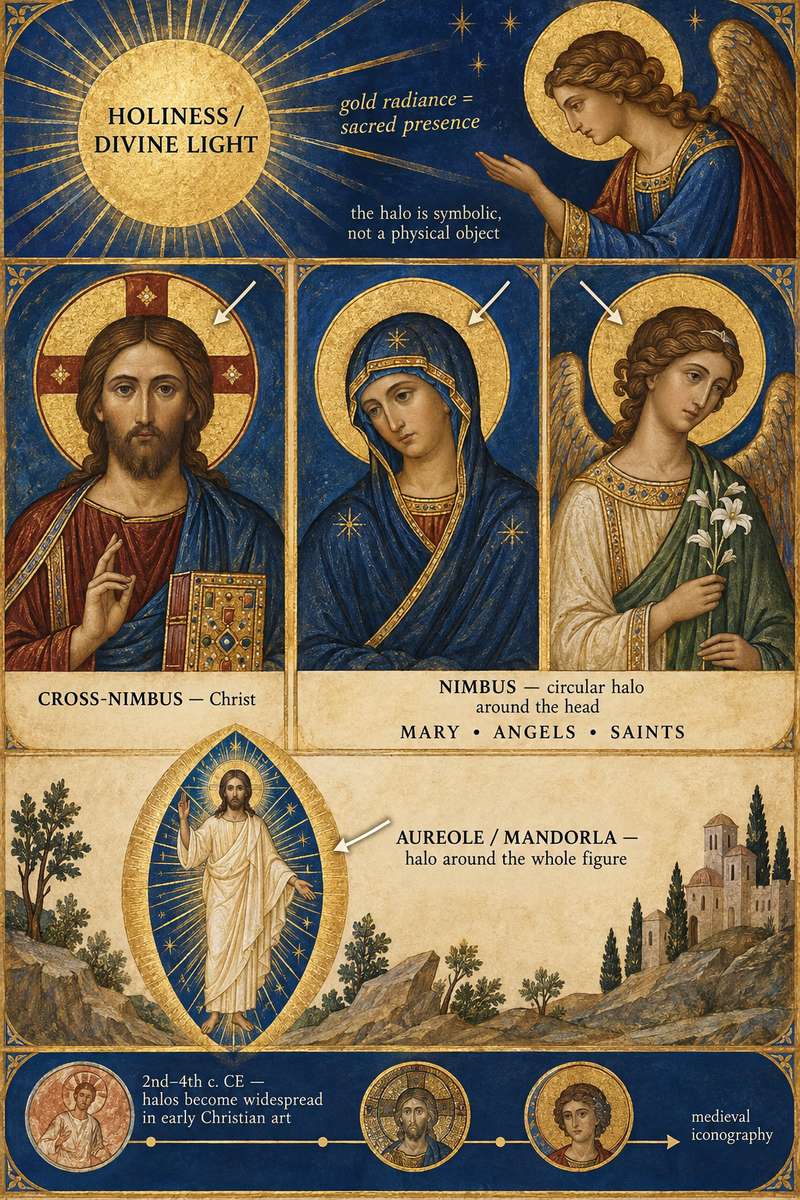
Art-historical vocabulary distinguishes several forms. 'Nimbus' or 'halo' usually denotes a head-disk, while 'aureole' or 'glory' can mean a full-body radiance. The almond-shaped full-body halo is called a 'mandorla.' These forms are not merely decorative: they signal different aspects of sanctity or the intensity of divine presence.
CONVENTIONS FOR CHRIST, MARY, ANGELS, AND SAINTS
Medieval and later Christian art developed conventions to mark various figures. A cruciform (cross-inscribed) halo is a conventional form reserved for Christ, emphasizing his unique divinity. Saints and angels commonly receive a plain circular halo. Mary often appears with special aureoles or, in some traditions, a distinguished form of radiance, while Christ may be shown within a mandorla for scenes that depict cosmic or transfiguring glory. These conventions help viewers read differing levels or types of holiness at a glance.
SACRED ART AND VISUAL LANGUAGE
In icons, frescoes, stained glass and panel paintings, halos function with composition, color, and gesture to communicate theological meaning. Artists use gold leaf, radiant lines, or a plain disk to suggest uncreated light or heavenly glory. The cruciform halo, aureole and mandorla became established visual cues so that viewers—learners and worshippers alike—could immediately recognize sacred figures and moments of revelation.
PRAYER AND HOME DEVOTION
Understanding the halo meaning in Christian art can deepen personal devotion and the use of sacred images in prayer corners. A print or icon that shows a halo invites meditation on divine light and the spiritual qualities the figure exemplifies—holiness, grace, or heavenly presence—helping families and individuals enter into contemplative reflection without reducing the image to mere decoration.
COMMON MISUNDERSTANDINGS
Beginners sometimes assume halos are purely decorative or that every halo means the same thing. The verified sources show instead that halos carry layered meanings and that specific forms—plain head-disks, cruciform halos, aureoles, mandorlas—convey different theological emphases and historical conventions rather than a single uniform sign.
CLOSING INTERPRETATION
The halo remains a powerful and recognisable symbol in Christian visual culture because it makes the invisible notion of divine light visible. From its pre-Christian roots to its firm establishment in late antiquity, the halo in its many forms helps viewers see holiness, read sacred scenes, and bring the language of heavenly radiance into worship, art and the home.
Author: Alex R.